
Dollar Hits One-Year High Against Shekel Amid Global and Local Factors
The U.S. dollar reached a one-year high against the Israeli shekel on Wednesday, trading at 3.27 shekels. This rise is driven by expected U.S. Federal Reserve interest rate hikes to combat inflation and a widening interest rate gap as Israel lowers its rates. Global market volatility, particularly in tech stocks, and political uncertainty in Israel following recent elections have also contributed to the shekel's weakening. Analysts have mixed expectations for the dollar's future trajectory.
הידיעה ב-5 שורות · תקציר של baba
- The U.S. dollar reached a one-year high of 3.27 shekels against the Israeli currency on Wednesday.
- Expected U.S. Federal Reserve interest rate hikes are strengthening the dollar globally.
- Israel's lower interest rates and recent inflation data suggest further rate cuts.
- Global market volatility and political uncertainty in Israel are weakening the shekel.
- Israeli institutional investors buying dollars to maintain asset exposure are also impacting the shekel.
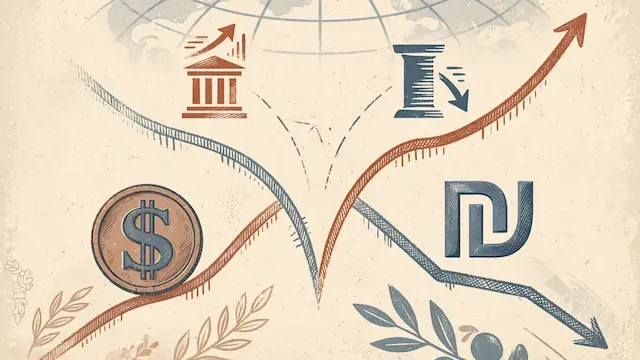
The U.S. dollar reached a new high against the Israeli shekel on Wednesday, trading at 3.27 shekels on the continuous market, its strongest point since November 2025. The euro also strengthened, trading around 3.59 shekels. This weakening of the shekel against the dollar has become a trend, with the dollar appreciating by approximately 8% since the beginning of September and about 17% since its low in late May. Several factors are contributing to this trend. Firstly, global economic conditions are playing a significant role. The dollar index, measuring its strength against major currencies, climbed to over 103.8 points, the highest since April 2025. This surge is attributed to expectations that the U.S. Federal Reserve will continue to raise interest rates to combat rising inflation. Christopher Waller, a member of the Fed's Board of Governors, suggested in a CNBC interview that a half-percentage-point rate hike might be necessary at the next meeting in early December. Markets are already pricing in a quarter-point increase with certainty and anticipate further hikes in January, a view shared by investment bank Goldman Sachs.
Secondly, the widening interest rate differential between the U.S. and Israel is benefiting the dollar. The Bank of Israel lowered its interest rate to 3.25% in September, while annual inflation in Israel dropped to 1.1% in October, fueling expectations of another rate cut on November 23. As U.S. rates rise and Israeli rates fall, the dollar becomes more attractive. Thirdly, global market volatility, particularly on Wall Street, is driving investors towards the dollar. The Democratic victory in U.S. midterm elections has raised concerns about potential regulation in the artificial intelligence sector. The resignation of Nvidia CEO Jensen Huang, amidst reports of personal misconduct and alleged ties to Chinese intelligence, has led to a significant drop in Nvidia's stock price. During such periods of uncertainty, investors tend to seek refuge in the dollar. This global downturn also impacts Israeli institutional investors, such as pension funds and insurance companies, which hold an estimated $500 billion in foreign assets. Approximately half of these assets are hedged, meaning they are protected against exchange rate fluctuations. However, as foreign stocks decline, these institutions need to purchase dollars to maintain their target exposure levels, further weakening the shekel.
Finally, domestic politics in Israel have also contributed to the shekel's decline. The October 27 elections resulted in no clear majority, leaving both blocs short of the 61 seats needed to form a government. In the immediate aftermath of the elections, the shekel lost 2.2% against the dollar, trading around 3.12 shekels. Since then, the dollar has appreciated by an additional 5%. However, not all analysts anticipate a continued surge. Dillon Wu, an analyst at Pepperstone, believes the December U.S. rate hike is already priced in and that a significant further strengthening of the dollar would require expectations of higher interest rates in 2027.
מוזכרים
אותו אירוע, כפי שכל מערכת דיווחה עליו בנפרד. פתחו כמה דיווחים כדי להשוות מה כל מערכת מדגישה, ומה היא משאירה בחוץ.
מרכז 2


לא אותו אירוע: ידיעות אחרות שחולקות עם הידיעה הזו אנשים, מקומות או נושא. רקע, תגובות והמשכים.




