
Israeli Election Stalemate Fuels Political Uncertainty and New Knesset Maneuvers
Israel faces a prolonged political crisis following the 26th Knesset elections, with neither Benjamin Netanyahu's bloc nor the "Change bloc" able to form a government. Netanyahu prevented the opposition from gaining a majority, but lacks the numbers himself. The Change bloc failed to replace him. Both sides are exploring strategies, including potential unity government talks, Knesset power plays by the opposition, and the possibility of repeat elections, leading to extended national uncertainty.
הידיעה ב-6 שורות · תקציר של baba
- Neither Benjamin Netanyahu nor the "Change bloc" secured a majority to form a government after Israel's 26th Knesset elections.
- Benjamin Netanyahu succeeded in preventing the opposition from forming a majority to replace him.
- The "Change bloc" managed to block Netanyahu but failed in their primary goal of replacing the government.
- A prolonged period of political uncertainty is expected, with options including unity government talks or repeat elections.
- The "Change bloc" is considering a strategy to shift Knesset power by replacing the Speaker, not forming a government.
- Both blocs believe time may eventually work in their favor, prolonging the political stalemate.
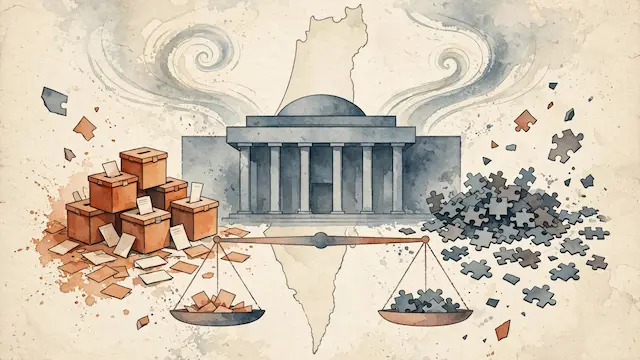
Israel's 26th Knesset elections concluded with a paradoxical outcome: neither the incumbent bloc led by Benjamin Netanyahu nor the "Change bloc" achieved their primary goals. Netanyahu succeeded in preventing the opposition from gaining a majority to replace him, but he also failed to secure the 61 seats needed to form his own government. The Change bloc, in turn, managed to block Netanyahu from forming a majority but could not muster enough support to establish a "Zionist" government and replace him.
This deadlock has plunged Israel into a prolonged period of political uncertainty. Netanyahu, despite leading the largest party, the Likud, faces the challenge of forming a coalition. His strategic advantage lies in time, as he continues to serve as interim Prime Minister. He may attempt to fracture the Change bloc, entice potential allies, or, if necessary, prepare for repeat elections, which he might not view as an insurmountable threat.
The Change bloc, spearheaded by Gadi Eisenkot, faces its own set of challenges. While successfully uniting four parties above the electoral threshold, questions remain about their focus on internal competition versus expanding their base. The political alliance between Naftali Bennett and Yair Lapid may have blurred Bennett's ability to present a right-wing alternative. Internal competition, such as Eisenkot's campaign for the largest party, may have diverted attention from broader coalition-building efforts. The bloc also struggled to present a unified stance on key security and national issues and avoided a decisive position on potential partnerships with Arab parties.
A "unity government" is presented as a potential solution to the impasse, but it faces significant hurdles. For the Change bloc, joining a government led by Netanyahu could be seen as a betrayal of their core promise to voters. Past experiences with Netanyahu, particularly for Benny Gantz, serve as a cautionary tale. Netanyahu's camp is reportedly trying to persuade Bennett to break away from Lapid, but this faces challenges, including insufficient mandates and potential alienation from his own voter base.
As forming a government appears distant, the Change bloc is exploring an alternative strategy: shifting the balance of power within the Knesset itself. A key move under consideration is replacing the current Knesset Speaker, Amir Ohana, with a majority vote. This could grant the bloc significant influence over the parliamentary agenda, committee compositions, and legislative initiatives, including a new conscription law, establishing a state inquiry commission for the October 7th events, and potentially reversing judicial overhaul laws.
Meanwhile, Netanyahu's strategy involves delegitimizing any cooperation with Arab parties and attempting to sow discord within the Change bloc. Repeat elections remain a possibility, though neither side is guaranteed a better outcome. The current situation suggests a prolonged period of political maneuvering, pressure campaigns, and potential shifts in Knesset control before a government is formed, all while Israel grapples with pressing security, economic, and social challenges.
מוזכרים
אותו אירוע, כפי שכל מערכת דיווחה עליו בנפרד. פתחו כמה דיווחים כדי להשוות מה כל מערכת מדגישה, ומה היא משאירה בחוץ.
מרכז 4ימין 1ערבית 1





לא אותו אירוע: ידיעות אחרות שחולקות עם הידיעה הזו אנשים, מקומות או נושא. רקע, תגובות והמשכים.




