
Israel Election Stalemate: Five Scenarios for Government Formation
תורגם ותומצת מתוך Vesty על ידי baba
Following the Israeli Knesset elections, no party has secured a majority, leading to a political stalemate. Five scenarios are being considered to form a government, including a unity government led by Benjamin Netanyahu, a rotation government, a government with defectors, or a minority government. If no agreement is reached, repeated elections are likely, potentially resulting in a similar deadlock.
הידיעה ב-5 שורות · תקציר של baba
- No party secured a majority in the 26th Knesset elections, creating a political deadlock.
- Benjamin Netanyahu's bloc has 53 seats, while the 'bloc for change' has 48 seats.
- A unity government led by Netanyahu is considered a realistic but promise-breaking scenario.
- Other potential scenarios include a rotation government or a minority government led by Gadi Eisenkot.
- Repeated elections are a possibility if no compromise is reached, potentially leading to a similar stalemate.
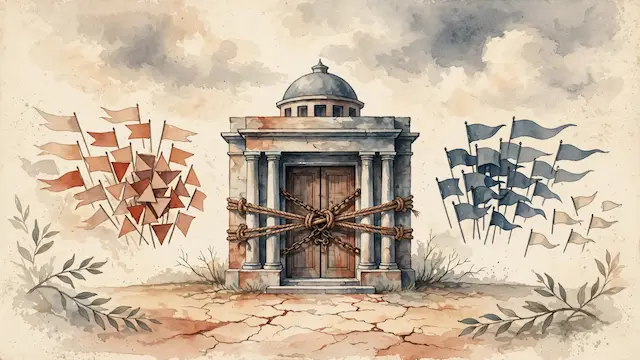
As the final votes are tallied for the 26th Knesset, Israel faces a political deadlock with no clear winner. The current projections indicate that neither the "bloc for change" nor the bloc led by Benjamin Netanyahu will secure the 61 seats needed for a majority, necessitating compromise from all parties. The "bloc for change" has secured 48 seats, while Netanyahu's bloc has 53 seats. The situation is described as a "dead end," with the possibility of repeated elections looming.
One realistic scenario involves a "government of unity" led by Netanyahu, which would require numerous politicians, including Netanyahu and leaders of the "bloc for change" like Gadi Eisenkot, Naftali Bennett, Avigdor Lieberman, and Yair Golan, to break campaign promises. This option has been discussed by President Yitzhak Herzog, who has pledged to prevent new elections, and is reportedly favored by the administration of U.S. President Donald Trump.
Another possibility is a "government based on rotation," a format previously used in Israel. While Netanyahu might be hesitant to enter such an arrangement given his current bloc's strength, it remains a potential option. For the "bloc for change," this scenario is highly undesirable as it could allow Netanyahu to retain power.
A third scenario suggests a "Netanyahu government with defectors from the bloc for change." This would involve politicians, primarily from Eisenkot's party, switching allegiances, potentially compromising their leaders. However, practical considerations might outweigh ideological stances.
A "minority or transitional government led by Eisenkot" is also considered, though it would likely depend on the support of Arab parties, a move that would break promises made by most "bloc for change" leaders, except for Yair Golan. While some Arab parties have expressed willingness to oppose Netanyahu, and the Likud party has filed complaints about voting irregularities in Arab sectors, such a government would struggle to form a stable coalition and could lead to the Knesset's dissolution.
Finally, "repeated elections" remain a possibility if no compromise is reached. This outcome would mean parties sticking to their principles but failing to form a government, potentially leading to a similar stalemate in the future.
מוזכרים
אותו אירוע, כפי שכל מערכת דיווחה עליו בנפרד. פתחו כמה דיווחים כדי להשוות מה כל מערכת מדגישה, ומה היא משאירה בחוץ.
מרכז 1ימין 1אחרים 1


לא אותו אירוע: ידיעות אחרות שחולקות עם הידיעה הזו אנשים, מקומות או נושא. רקע, תגובות והמשכים.


