
Dollar Plummets Against Shekel Amidst Election Uncertainty
תומצת מתוך Bizportal על ידי baba
The U.S. dollar has fallen sharply against the Israeli shekel, trading around 3.04 shekels, while the dollar index strengthened globally. This local trend is attributed to reduced political uncertainty surrounding the upcoming elections, with investors anticipating a stable outcome. A weaker dollar benefits importers and consumers but hurts exporters, while institutional hedging and foreign investment also influence the exchange rate. The Bank of Israel may intervene if the shekel strengthens too rapidly.
הידיעה ב-5 שורות · תקציר של baba
- The U.S. dollar fell significantly against the Israeli shekel, reaching approximately 3.04 shekels.
- The shekel's strength is linked to reduced political uncertainty surrounding the upcoming Israeli elections.
- Global dollar index rose, indicating the shekel's appreciation is driven by domestic factors.
- A weaker dollar benefits Israeli importers and consumers but harms exporters.
- Institutional investors' hedging strategies and foreign investment also impact the exchange rate.
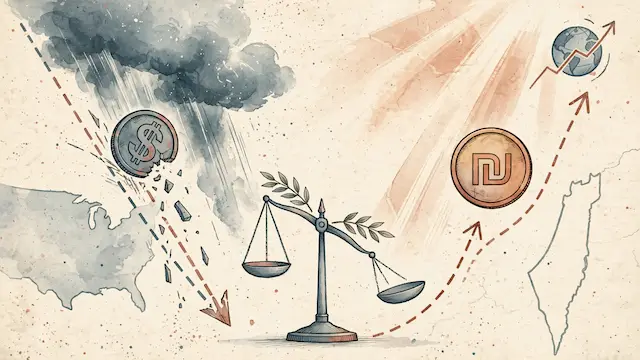
The U.S. dollar has experienced a sharp decline against the Israeli shekel, trading around 3.04 shekels, a drop of approximately 1.1% from the previous day's closing. The Bank of Israel's representative rate was set at 3.078 shekels, marking a 1.09% decrease. The euro also weakened against the shekel, with its representative rate at 3.4462 shekels, down about 1.1%, and trading around 3.39 shekels in continuous trading. This local weakening contrasts with the dollar's global performance, as the Dollar Index (DXY) rose about 0.25% to around 102.2 points, indicating that the shekel's strength is driven by domestic factors rather than a global flight from the U.S. currency.
Market participants attribute the shekel's appreciation primarily to a perceived reduction in political uncertainty surrounding the upcoming Knesset elections. Investors anticipate that a stable government outcome could lower the risk premium on Israeli assets, attracting foreign capital, boosting the economy, and strengthening the stock market. Conversely, a prolonged political stalemate or a government perceived as increasing institutional or security risks could rapidly revive demand for the dollar. The influence of institutional investors hedging their currency exposure also plays a role; as overseas stock markets rise, their dollar exposure increases, prompting them to sell dollars to rebalance their portfolios. Foreign investment in high-tech and employee option expirations further contribute to dollar supply in the local market.
A weaker dollar negatively impacts Israeli exporters, reducing their shekel-denominated revenues. For instance, a software company receiving one million dollars monthly would earn approximately 30,000 shekels less if the exchange rate falls from 3.07 to 3.04 shekels, assuming sales volume remains constant. Importers and consumers benefit from a stronger shekel, as foreign holidays and imported goods become cheaper, although bank conversion margins can mitigate some of these savings. For Israeli investors with dollar-denominated portfolios, a falling dollar offsets some of their returns in shekel terms. The Bank of Israel retains the option to intervene in foreign exchange trading to moderate rapid shekel strengthening and protect exporters, but the effectiveness of such intervention is limited when the trend is driven by significant capital flows or changes in risk premiums. With Israeli inflation at 1.6% and the interest rate at 3.25%, the central bank has room to monitor the situation without immediate policy changes.
לא אותו אירוע: ידיעות אחרות שחולקות עם הידיעה הזו אנשים, מקומות או נושא. רקע, תגובות והמשכים.



