
Study Finds Israel's 'Basket of Goods' Program Cuts Prices on Selected Items but Raises Others
תומצת מתוך Behadrei Haredim על ידי baba
A study of Israel's 'Basket of Goods' program shows significant price cuts on selected items at Carrefour stores but reveals widespread price increases on other products, potentially offsetting consumer savings. The program's competitive impact on other chains was limited and price competition was national rather than local.
הידיעה ב-6 שורות · תקציר של baba
- Israel's 'Basket of Goods' program cut prices by about 35% on selected items at Carrefour stores.
- Price increases occurred in 46 out of 76 non-basket product categories at Carrefour, some significantly.
- Other supermarket chains showed limited price reductions on basket items, mostly under 10%.
- Online Carrefour saw a 37% price drop on basket items but also broad price hikes on other products.
- Popular non-basket products rose about 1.5%-2% in price at Carrefour physical and online stores.
- Price competition was national, with no local price differences near participating Carrefour stores.
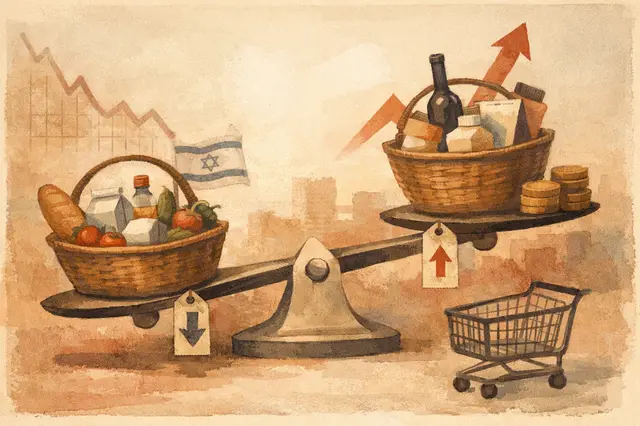
A pioneering study evaluated Israel's flagship economic initiative, the "Basket of Goods" program, two months after its launch, revealing a complex impact on consumer prices. Conducted by Prof. Itay Atar and Adi Omer from Tel Aviv University's Coller School of Management and Dr. Or Avishi-Rizhi from Pompeu Fabra University in Barcelona, the research analyzed daily price data from Pricez across about 70 supermarket sub-chains and over 2,000 stores nationwide during the program's first seven weeks.
The program, implemented by Carrefour in 50 physical stores and online for six months, committed to selling a basket of 100 products for a total of 1,098 shekels, down from an average of approximately 1,700 shekels before the launch. The government supported Carrefour with a 50 million shekel advertising campaign. The study found that prices of basket products in participating Carrefour stores dropped by about 35%, with a 37% decrease online. Non-participating Carrefour stores also saw a 6% price reduction, indicating some spillover effect.
However, outside Carrefour, the program's influence was limited. Large discount chains showed modest price cuts on basket items: Machsanei HaShuk led with a 10% drop, Half Hahinam 5%, Yohananof 4%, Victory and Rami Levy about 3%, while Shufersal Deal, Super-Pharm, and Osher Ad did not show significant reductions. Online competitors averaged only a 2.3% decrease, with Rami Levy online cutting prices by 9%, Half Hahinam by 4%, but Shufersal and Machsanei HaShuk online showed no significant changes.
A notable finding was widespread price increases in non-basket products sold at Carrefour stores participating in the program. Among 76 product categories examined, 46 experienced price hikes, with 23 statistically significant. Examples include laundry gels (+9%), puddings and jellies (+7%), adult shampoo and conditioner (+7%), pasta (+6%), and flavored butter cookies (+6%). Online Carrefour showed even broader increases in 55 categories, with 31 significant, including a 14% rise in shampoo and conditioner and 9% in biscuits.
The researchers also found that 86 popular non-basket products increased in price by about 1.5% in physical Carrefour stores and 2% online. Price competition was national rather than local, as no differences were found between cities with or without participating Carrefour stores. Prof. Atar concluded that while the program successfully lowered prices on targeted items, consumers may pay more overall due to price hikes elsewhere, potentially negating the intended savings.
מוזכרים
אותו אירוע, כפי שכל מערכת דיווחה עליו בנפרד. פתחו כמה דיווחים כדי להשוות מה כל מערכת מדגישה, ומה היא משאירה בחוץ.
מרכז 3ימין 2חרדית 1אחרים 2







