
Study Finds Israel’s Government Food Basket Program Cuts Some Prices but Triggers Broader Price Increases
A study analyzing Israel's "Basket of Israel" program found that while Carrefour significantly lowered prices on 100 government-selected products, many other items saw price increases, potentially offsetting consumer savings. The initiative, launched in April 2026, aimed to reduce grocery costs but triggered mixed market reactions and broader inflation in non-basket products.
הידיעה ב-6 שורות · תקציר של baba
- Carrefour reduced prices of 100 basket products by 35% in stores and 37% online under the government program.
- Other supermarket chains showed limited price drops, mainly discount chains with 3-10% decreases.
- Prices of many non-basket products at Carrefour rose significantly, with some categories increasing over 9%.
- Online price hikes were more severe, with 55 product categories showing increases, including 14% for shampoo.
- Overall, consumers may not save money due to price rises in other goods, negating basket discounts.
- The program faced criticism for subsidizing a private company and limited market-wide impact.
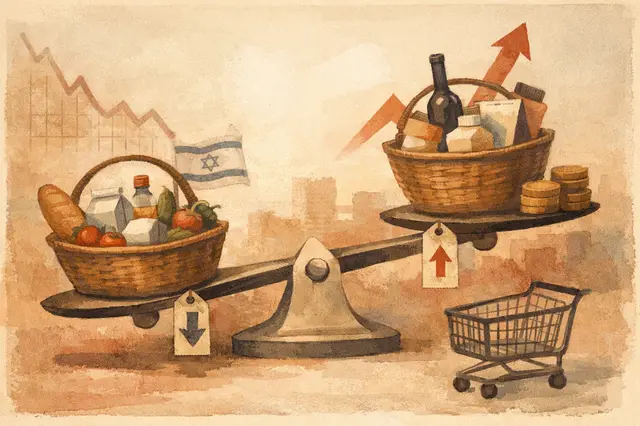
A recent study by the Coller School of Management at Tel Aviv University and Pompeu Fabra University in Barcelona evaluated Israel's flagship economic initiative, "The Basket of Israel," two months after its launch on April 15, 2026. The program, led by the Ministry of Economy, tasked Carrefour, the sole supermarket chain to win the government tender, with selling 100 common consumer products at a fixed total price of 1,098 shekels, down from an estimated average of 1,700 shekels. In exchange, Carrefour received a 50 million shekel government budget for a wide advertising campaign.
The research, conducted by Prof. Itay Atar, Adi Omer, and Dr. Or Avishi-Rizi using data from over 70 sub-chains and 2,000 stores, revealed a complex outcome. Prices of basket products at participating Carrefour stores dropped by 35% in physical locations and about 37% online, with a smaller 6% decrease in non-participating Carrefour stores. However, outside Carrefour, the price reductions were limited, with only discount chains like Machsanei HaShuk, Half Hahinam, and Yohananof showing modest decreases between 3% and 10%. Other major chains showed no significant price drops.
The study’s most concerning finding was a widespread price surge in products outside the government basket, particularly within Carrefour stores. Among 76 narrow product categories related to the basket but not included in it, 46 categories saw price increases in physical stores, with 23 statistically significant. Notable hikes included laundry gel (9%), pudding and jelly (7%), adult shampoo and conditioner (7%), pasta (6%), and flavored butter cookies (6%). Online, price increases were even more pronounced, with 55 categories rising, including a 14% jump in adult shampoo and conditioner and 9% in biscuits.
Researchers also examined 86 popular food items unrelated to the basket and found average price increases of 1.5% in physical Carrefour stores and 2% online. Prof. Atar summarized, "The program succeeded in lowering basket product prices in Carrefour stores and somewhat among competitors, but there are no free lunches in economics. Price hikes in many other categories mean consumers may pay more overall, negating the savings. The true test is the total bill at checkout, which may have risen despite the program." The findings highlight the challenges of controlling inflation and market dynamics through targeted price interventions.
The initiative has faced criticism for subsidizing a private company with public funds and for limited market impact, with Economy Minister Nir Barkat defending the program and criticizing food monopolies and retailers for allegedly boycotting the tender and coordinating positions. The study’s results provide a nuanced view of the program’s effects on Israeli consumers and the broader retail market.
מוזכרים
אותו אירוע, כפי שכל מערכת דיווחה עליו בנפרד. פתחו כמה דיווחים כדי להשוות מה כל מערכת מדגישה, ומה היא משאירה בחוץ.
מרכז 3ימין 2חרדית 1אחרים 2







