
Israeli Supreme Court Reviews Petitions Against Michael Regev's State Comptroller Appointment
The Israeli Supreme Court is reviewing petitions against Michael Regev's appointment as State Comptroller, focusing on allegations that Knesset members violated voting secrecy by recording themselves during the parliamentary vote. The court debated the legal implications of these recordings and the principle of ballot confidentiality, with tensions arising during the hearing. The outcome will determine the legitimacy of Regev's appointment.
הידיעה ב-6 שורות · תקציר של baba
- Supreme Court reviews petitions challenging Michael Regev's State Comptroller appointment.
- Petitioners claim Knesset members recorded votes, breaching ballot secrecy.
- Court president recalled prior rulings criticizing the appointment process.
- MK Tali Gottlieb was removed from the hearing after interrupting.
- Justices debated absence of explicit rules banning vote recordings.
- Justice Sohlberg stressed voting must remain secret behind curtains.
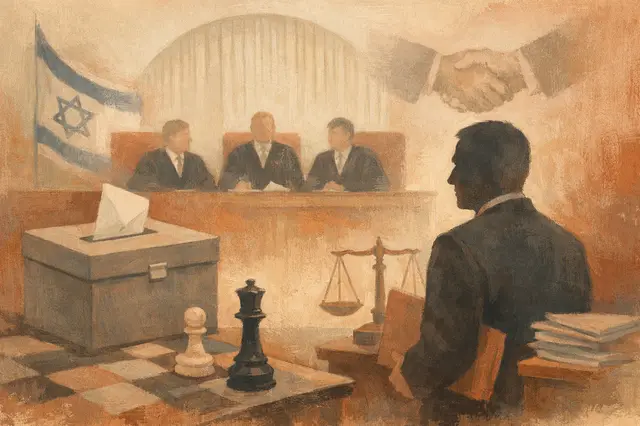
The Israeli Supreme Court convened a panel of five justices on June 28, 2026, to hear petitions challenging the appointment process of Michael Regev as State Comptroller. Petitioners argued that the parliamentary vote was flawed because members of the Knesset recorded themselves voting, violating the principle of ballot secrecy. Present in the courtroom were Knesset members Tali Gottlieb, Miki Levy, and Karin Elharar. During the session, Supreme Court President Itzhak Amit recalled previous rulings that described an "undesirable cloud" over the process and noted that the court had issued a conditional order which the Knesset Speaker rejected.
Tensions arose when MK Tali Gottlieb interrupted the hearing and was asked to leave by the court president, leading to a brief confrontation. Legal counsel for the Knesset, Attorney Yitzhak Bart, argued there was no explicit prohibition against MKs recording their votes behind the voting booth curtain. Justice Barak-Erez questioned the implications of this absence of clear rules, suggesting past practices might have been improper. Justice Ruth Ronen noted a possible informal atmosphere encouraging MKs to document their votes, potentially pressuring others to do the same.
Justice Sohlberg criticized the Knesset members for undermining ballot secrecy, emphasizing that voting should remain confidential behind a curtain despite freedom of speech before and after voting. The court debated the lack of explicit legal provisions on whether voters may film themselves during the vote, with references to historical Jewish law practices. Attorney Bart acknowledged that while MKs can disclose their votes, the secrecy inside the voting booth remains essential. The court's deliberations focused on whether the secrecy principle was effectively nullified by the recordings and what that means for the legitimacy of Regev's appointment.
The hearing continues as the court weighs the legal and procedural validity of the voting process that led to Michael Regev's selection as State Comptroller, a key oversight position in Israel's government.
מוזכרים
אותו אירוע, כפי שכל מערכת דיווחה עליו בנפרד. פתחו כמה דיווחים כדי להשוות מה כל מערכת מדגישה, ומה היא משאירה בחוץ.
מרכז 5ימין 3חרדית 2אחרים 2











