
Iran Plans Oil Convoy Challenge to US Navy in Strait of Hormuz
Translated & summarized from Cursorinfo by baba
Iran is reportedly planning a "Fereydoun" operation to send oil tankers through the Strait of Hormuz, challenging the U.S. maritime blockade. The convoy, potentially carrying civilians to deter intervention, aims to break sanctions that threaten to reduce Iran's oil revenue to near zero by mid-December. Iran also threatens retaliation against regional energy infrastructure if the convoy is intercepted. The U.S. faces difficult choices with significant risks, while Israel is monitoring the escalating tensions.
The story in 6 lines · by baba
- Iran plans "Fereydoun" operation to send oil tankers through Strait of Hormuz, challenging U.S. blockade.
- Operation aims to break sanctions threatening to reduce Iran's oil revenue to near zero by December.
- Iran threatens retaliation against regional energy infrastructure if convoy is intercepted by U.S.
- U.S. faces difficult choices with significant risks in responding to the planned convoy.
- Israel is closely monitoring the situation and potential escalation.
- Operation may include civilians aboard tankers to deter U.S. intervention.
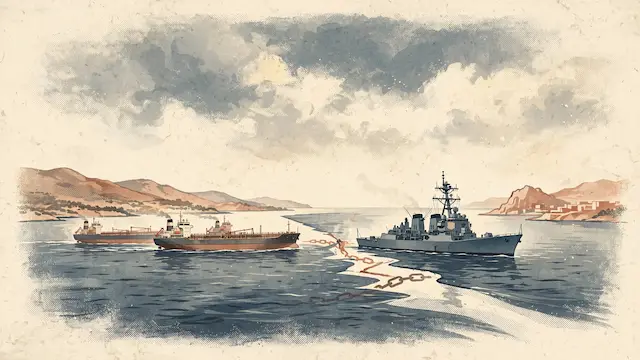
Iran is reportedly considering a risky operation to break the U.S. maritime blockade by sending a convoy of oil tankers through the Strait of Hormuz. Western intelligence sources indicate that Tehran is planning to dispatch tankers under Iranian flags, with China designated as the destination. The operation, reportedly codenamed "Fereydoun," aims to present the U.S. with a difficult choice: allow the ships to pass and ease pressure on Iran, or attempt to intercept them and risk military escalation. To deter intervention, Iran may equip the tankers with activated Automatic Identification System (AIS) transponders and potentially place journalists, civilians, and international activists aboard to raise the political stakes of any U.S. action. The island of Kharg, which handles 85-90% of Iran's crude oil exports, is central to this plan, as its terminal is crucial for large oil tankers.
Beyond a direct convoy, Iran is exploring options like transferring oil to foreign tankers that might evade U.S. scrutiny. A potential instance of this occurred on November 17, when approximately 200,000 barrels of oil were reportedly transferred from the tanker OLYM to the HAO FAN near Kharg. However, there is no confirmation that this oil left the blockade zone. In response, the U.S. Central Command (CENTCOM) expanded restrictions on November 18 to include vessels receiving Iranian oil via ship-to-ship transfers. Since the U.S. reimposed its blockade in July, no Iranian oil tankers have successfully transited the Gulf of Oman undetected. This intensified pressure, with Kpler estimating Iran's oil and condensate export revenues could near zero by mid-December, likely drives Tehran's consideration of more dangerous measures.
Iran's initiative also carries a regional threat. Tehran warns that if the U.S. attempts to stop or damage the convoy, Iran will retaliate against the energy infrastructure of Saudi Arabia, the UAE, and Qatar, potentially disrupting global energy supplies. Former IRGC commander Mohsen Rezaei stated he received instructions from Mojtaba Khamenei to end the current state of "neither war nor peace." Foreign Minister Abbas Araghchi and Deputy Foreign Minister Kazem Gharibabadi have also vowed to break the blockade, with Gharibabadi calling U.S. restrictions an "act of war," though Iran remains open to negotiations via intermediaries like Qatar.
The U.S. faces several options for countering the convoy. These range from using force to disable the tankers, risking environmental disaster and regional tensions, to precision strikes on engine rooms, which could cause casualties and provoke retaliation. Capturing the vessels with Marines is another possibility, though it carries risks, especially if armed IRGC members are aboard. The article draws a parallel to the 2010 Mavi Marmara incident, suggesting a potential for violent confrontation if tanker crews resist. Iran may be deliberately balancing on the edge of conflict to gain concessions from the Trump administration.
Israeli intelligence and the IDF are closely monitoring the situation. While initial Iranian retaliation might target Gulf states' energy facilities rather than Israel, a significant U.S. response could draw Israel into military action. The core U.S. dilemma is that any decision, allowing the convoy to pass or attempting to stop it, involves substantial risks.
Keep up with
Mentioned

