
France's Shifting Stance: From Israeli Ally to Critic
Translated & summarized from i24NEWS Arabic by baba
France's relationship with Israel has shifted from a close alliance in the mid-20th century, marked by arms deals and nuclear cooperation, to significant criticism today. Key turning points include President Charles de Gaulle's 1967 arms embargo and subsequent controversial remarks, pushing Israel towards the US. Despite later incidents like the "Saar 3" missile boat acquisition and French arms deals with Iraq, diplomatic tensions persisted. Under President Macron, France has adopted a firm stance against Israeli policies in Gaza and the West Bank, banning Israeli defense firms from fairs and calling for an arms supply halt, driven by domestic demographics, Gaullist diplomacy, and regional interests.
The story in 6 lines · by baba
- France's relationship with Israel has shifted from a close alliance to significant criticism.
- During the 1950s-60s, France was Israel's main arms supplier and strategic partner.
- President Charles de Gaulle imposed an arms embargo on Israel in 1967.
- Israel acquired French missile boats in 1969 through a covert operation.
- President Macron has called for a halt to arms supplies to Israel for use in Gaza.
- France's current stance is influenced by domestic demographics, Gaullist diplomacy, and regional interests.
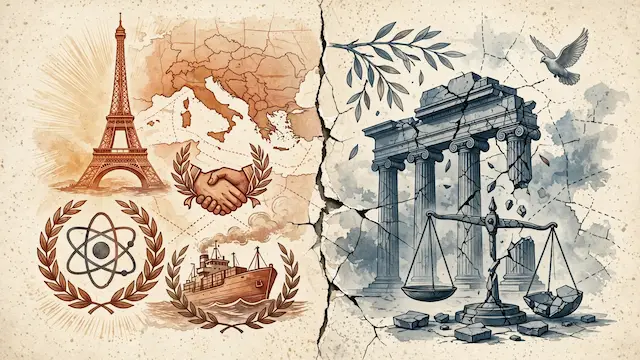
France's relationship with Israel has undergone a dramatic transformation from a close strategic alliance in the mid-20th century to a position of significant criticism today. In the 1950s and 1960s, France was Israel's primary arms supplier and a key strategic partner, notably aiding in the establishment of the Dimona nuclear research center and supporting Israel during the 1956 Sinai campaign. This era, often called the "golden age," saw France provide crucial military hardware, including Mirage fighter jets that were instrumental in the 1967 Six-Day War. The initial ties were forged in the post-WWII era, with France assisting clandestine Jewish organizations and later supplying arms during Israel's 1948 War of Independence, defying international embargoes.
The alliance deepened due to shared strategic interests, particularly France's conflict with Algerian rebels supported by Egyptian President Gamal Abdel Nasser. This led to secret agreements, including the 1956 tripartite alliance with Britain and Israel against Egypt and, crucially, a 1957 pact for France to provide technology and materials for Israel's Dimona nuclear facility. France also supplied Dassault aircraft, including the Mirage III, ensuring Israeli air superiority.
A turning point occurred in spring 1967 when President Charles de Gaulle, seeking to improve relations with the Arab world, warned Israel against initiating conflict. Following the outbreak of the Six-Day War, de Gaulle imposed a comprehensive arms embargo, significantly impacting Israel, which was heavily reliant on French weaponry. This embargo included withholding 50 paid-for Mirage 5 fighter jets and spare parts. De Gaulle's subsequent controversial remarks about Jewish people further strained relations, pushing Israel to rely more on the United States and develop its domestic defense industry.
Despite the embargo, Israel ingeniously circumvented French restrictions to acquire five advanced Sa'ar 3 missile boats built in Cherbourg. In a daring operation in December 1969, the boats were "sold" to a Norwegian company and sailed to Haifa during a storm, marking a definitive end to French military support.
Throughout the 1970s and 1980s, France pursued a policy of "Arab policy," including supplying Iraq with a nuclear reactor, which Israel later destroyed in Operation Opera. The period also saw attacks on Jewish targets in Paris, bringing the Middle East conflict to French soil. While President François Mitterrand's visit to Israel in 1982 was a diplomatic step, he also advocated for a Palestinian state.
Under President Jacques Chirac in the 1990s, France sought to reassert its influence in the Middle East, particularly in Lebanon, playing a key role in mediating ceasefires. However, tensions flared during Chirac's 1996 visit to Jerusalem when he had a public confrontation with Israeli security guards.
In the 21st century, relations remained complex. President Nicolas Sarkozy, despite his pro-Israel stance on security, criticized settlement expansion. President François Hollande's France took a notably tough stance against Iran's nuclear program, earning quiet appreciation from Israel. The 2015 terrorist attacks in Paris, including the Hypercacher kosher supermarket siege, created a moment of shared grief and solidarity, though they also deeply unsettled France's Jewish community.
Since 2017, President Emmanuel Macron has maintained a policy of balancing close security and technological cooperation with strong criticism of Israeli policies. He has opposed West Bank annexation and settlement expansion, emphasizing the need for a two-state solution. Following the October 7, 2023 Hamas attacks and the subsequent war in Gaza, Franco-Israeli relations have reached a new low. France has banned Israeli defense companies from participating in arms fairs and Macron has called for a halt to arms supplies to Israel for use in Gaza. Underlying France's current stance are domestic demographic pressures from its large Muslim population, a Gaullist diplomatic tradition of seeking an independent global role, and historical ties to the Middle East, particularly Lebanon.
Mentioned
Not the same event — other stories that share this one’s people, places, or theme: background, reactions, and follow-ups.
