
Iran Builds Deep Underground Complex Near Isfahan, Satellite Images Reveal
Translated & summarized from Cursorinfo by baba
Satellite images show a large, deep underground complex being built north of Isfahan, Iran, possibly for the IRGC's missile program. The facility, potentially reaching over 200 meters deep, is significantly deeper than Iran's Fordow nuclear site. Construction began in January 2026 and has continued despite ongoing conflicts. The discovery comes amid U.S. discussions on military action against Iran, with Israeli leadership reportedly pushing for a quicker response.
The story in 5 lines · by baba
- Iran is constructing a deep underground complex north of Isfahan, potentially a new IRGC missile base.
- The complex may reach depths exceeding 200 meters, significantly deeper than the Fordow nuclear facility.
- Satellite imagery shows five entrances and ongoing construction, with initial plans altered due to geology.
- The facility's purpose is unconfirmed but resembles known Iranian missile bases.
- The discovery coincides with U.S. deliberations on military action against Iran and Israeli pressure for a response.
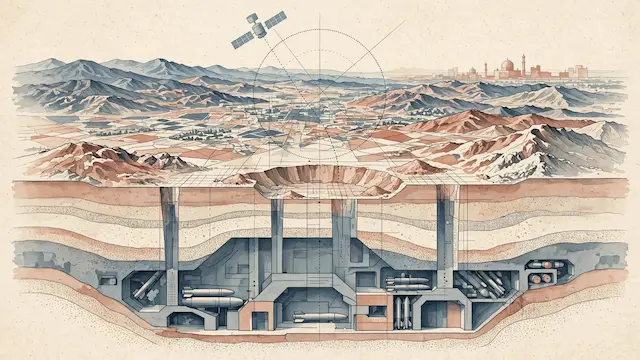
Satellite imagery has revealed a large underground complex under construction north of Isfahan, Iran, potentially reaching depths of 200 meters or more. Researchers suggest this facility may serve as a new missile base for the Islamic Revolutionary Guard Corps (IRGC), designed for enhanced protection against aerial attacks. The site was initially identified by Israeli OSINT researcher Ben Zion McCollums and later analyzed by Sam Lear for Arms Control Wonk, who published findings based on Planet Labs satellite images.
Construction began in January 2026 and continued through the war period. The project involved building access roads, preparing sites for equipment, and erecting auxiliary structures. A notable feature is a small, berm-enclosed area believed to be for storing explosives used in tunneling. Satellite views show five entrances to the underground system, with ongoing construction evidenced by spoil heaps, tunnel activity, and concrete production facilities.
Analysis indicates a change in the original construction plan, with tunneling efforts on the western side of a mountain abandoned after several months. The differing soil colors at the abandoned site compared to active entrances suggest challenging geological conditions. Lear estimates that tunnels could be located around 150 meters below the surface, potentially reaching over 200 meters deep within the mountain's central mass.
This depth significantly exceeds that of Iran's Fordow nuclear enrichment facility, which is estimated to be 80-100 meters underground. Such depth could provide substantial protection against penetrating aerial munitions, though actual defense depends on geology, construction, and weaponry. Lear noted similarities in the site's location and entrance configuration to known IRGC missile bases, leading to the hypothesis that it is intended for the IRGC's Aerospace Force.
The facility's exact purpose remains unconfirmed. Confirmation would require the appearance of typical missile base infrastructure, such as garages for specialized vehicles and rocket testing buildings. If such structures are not built, the initial assessment of the complex's purpose may need revision. The discovery occurs amid discussions in the U.S. about potential military action against Iran. President Donald Trump expressed a desire to wait and assess the situation after the new year, while Prime Minister Benjamin Netanyahu is reportedly urging quicker action. Disagreements also exist regarding alleged Iranian chemical weapons development, with Mossad head Roman Gofman presenting intelligence to U.S. officials suggesting accelerated research and testing.
Keep up with
Mentioned
The same event, reported separately by each outlet. Open a few to compare what different newsrooms emphasize — and what they leave out.
Centre 2Haredi 1Other 1




Not the same event — other stories that share this one’s people, places, or theme: background, reactions, and follow-ups.
