
Author Warns of "Civil War" Beneath Knesset Political Strife
Translated & summarized from Maariv by baba
Author Ran Adelist claims the political conflict in Israel's Knesset is a facade for an ideological "civil war" between opposing camps. He warns that the losing side is using disruptive tactics, potentially including violence, to prevent the formation of the elected government. Adelist believes the core struggle is between a religious-nationalist right and a liberal-democratic left, suggesting reconciliation is impossible without separation. He anticipates Netanyahu facing investigations if he leaves office and advises patience and legislative action to navigate the current turmoil.
The story in 5 lines · by baba
- Author Ran Adelist warns of an ideological "civil war" beneath the surface of Israeli Knesset politics.
- He claims the losing election side is using disruptive tactics, possibly including violence, to hinder the new government.
- Adelist describes the conflict as a clash between a religious-nationalist right and a liberal-democratic left.
- He suggests Netanyahu will face investigations if he relinquishes the Prime Minister role.
- The author advises patience and legislative action to manage the current political crisis.
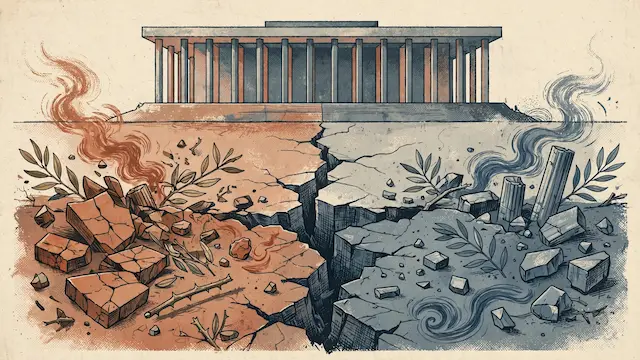
Author Ran Adelist argues that the current political conflict in the Knesset between the coalition and the "change bloc" is a superficial manifestation of a deeper ideological "civil war." He contends that the losing side in the recent elections is employing various tactics, including violence, to disrupt the formation of the elected government and create a security emergency.
Adelist describes the current situation as a Machiavellian scheme driven by a messianic ideology, designed to provoke chaos and hinder the new government's establishment. He asserts that the conflict is fundamentally ideological, pitting a right-wing vision of Israel as a Jewish state undergoing religious redemption against a liberal-democratic left that champions freedom of expression and acceptance of others. He believes these two ideologies are irreconcilable without a mutual agreement for separation into autonomous entities.
The author suggests that if Netanyahu steps down as Prime Minister, he will face numerous criminal investigations. Adelist anticipates a barrage of leadership tactics from Netanyahu in the coming months, including cabinet meetings, threats, bribery offers, and fabricated scandals.
Adelist proposes that the only way to manage the situation is through patience, immediate legislative action utilizing the majority, and addressing violent incidents with the support of the obtained majority. He criticizes the idea of returning Israel to a past era, which he believes would enable the flourishing of messianic, violent, and corrupt factions. He expresses doubt that the current "change government" is focused on necessary reforms, suggesting that life circumstances may eventually guide it toward a path of inclusivity, starting with Arab citizens of Israel and extending to the Palestinians, which he illustrates with a vision of normalized economic activity in Palestinian cities.
Mentioned
