
Jordan Invests in Water Independence, Potentially Weakening Israel's Strategic Leverage
Translated & summarized from Calcalist by baba
Jordan has launched a major desalination project in Aqaba to secure its water supply and reduce dependence on Israel. The facility, costing $6.7 billion, will produce 300 million cubic meters of water annually, significantly exceeding the amount Jordan currently receives from Israel. This move could diminish Israel's strategic leverage, although full water independence for Jordan is not expected until late 2030, and some dependencies, like natural gas, will remain.
The story in 6 lines · by baba
- Jordan launched a major desalination project in Aqaba to achieve water independence.
- The $6.7 billion project will produce 300 million cubic meters of water annually.
- This output is six times the additional water Jordan received from Israel.
- The initiative aims to reduce Jordan's dependence on Israel for water.
- Israel may lose strategic leverage as Jordan's water self-sufficiency grows.
- The first water delivery from the new plant is expected by the end of 2030.
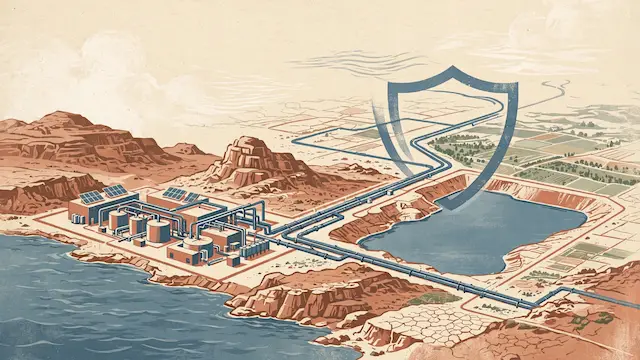
Jordan launched one of the world's largest desalination projects on Wednesday, a massive facility in Aqaba intended to supply water to the country's north. The primary goal is to alleviate a severe water shortage and reduce reliance on external sources, particularly Israel. The project involves a desalination plant near Eilat that will produce approximately 300 million cubic meters of water annually, meeting about 40% of Jordan's drinking water needs. This water will be transported via a 417-kilometer pipeline to the Amman region. The estimated investment for this initiative is $6.7 billion, with the first water delivery anticipated by the end of 2030.
This development carries significant strategic implications for Israel. Under the 1994 peace treaty, Israel supplies Jordan with 50 million cubic meters of water per year. While Israel agreed in 2021 to provide an additional 50 million cubic meters annually, this supplementary agreement expired at the end of 2025 and has not been renewed. The new Jordanian facility is projected to produce six times the amount of water that Jordan received as an annual addition from Israel.
As Jordan becomes more self-sufficient in its water supply, its dependence on Israel will decrease, diminishing Israel's ability to use water as a diplomatic tool. This project also aligns with Jordan's decision not to proceed with the "water-for-power" initiative with Israel, which would have involved Jordan receiving 200 million cubic meters of desalinated water annually in exchange for solar power. Essentially, Jordan aims to reduce its vulnerability in a critical area of dependence on Israel.
However, this transition will not be immediate. The project is in its early stages, with water expected only by late 2030. Even then, mutual dependence will not entirely disappear. The 1994 water agreement will remain in effect, and Jordan continues to rely on Israel for natural gas supplies.
The same event, reported separately by each outlet. Open a few to compare what different newsrooms emphasize — and what they leave out.
Centre 1Other 1
