
Jordan Launches Massive Water Project Amidst Regional Tensions
Translated & summarized from Ynet by baba
Jordan has launched its "National Water Carrier" project, a $6.6 billion initiative to desalinate water from Aqaba and supply 40% of the kingdom's drinking needs by late 2030. Spearheaded by Prince Faisal bin Hussein, the project aims to enhance water security and reduce reliance on external sources. The launch comes amid ongoing water disputes with Israel, highlighting Jordan's strategic move towards greater water independence.
The story in 6 lines · by baba
- Jordan launched its "National Water Carrier" project costing $6.6 billion to supply 40% of its drinking water.
- The project aims to desalinate water from Aqaba and transport it to various regions by late 2030.
- Prince Faisal bin Hussein inaugurated the initiative, highlighting its importance for national water security.
- The project's infrastructure includes a 417 km pipeline and solar power generation.
- Jordan's water security efforts are amplified by ongoing disputes with Israel over water supply agreements.
- Jordan previously canceled a "water for energy" deal with Israel in November 2023.
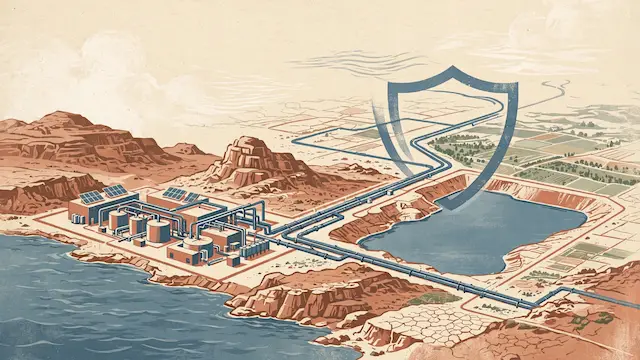
Jordan has officially launched its ambitious "National Water Carrier" project, a significant undertaking aimed at bolstering the kingdom's water security. The initiative, spearheaded by Prince Faisal bin Hussein, brother of King Abdullah II, was inaugurated in Aqaba. The project, with an estimated cost of $6.6 billion, is designed to supply approximately 40% of Jordan's drinking water needs by desalinating water from the Gulf of Aqaba and transporting it to various regions. Construction is expected to take about four years, with pumping operations anticipated to commence in the final quarter of 2030.
The "National Water Carrier" aims to enhance long-term water security, diversify supply sources, improve conveyance efficiency, and alleviate pressure on existing resources. According to Minister of Water and Irrigation Raed Abu Al-Saud, the project will annually provide 300 million cubic meters of desalinated water. The infrastructure will include a 417-kilometer pipeline from Aqaba to Amman, pumping systems capable of lifting water up to 1,100 meters, and solar power generation to meet about 30% of the project's electricity demands.
Jordan's Prime Minister Jafar Hassan hailed the project as the "largest strategic initiative in the history of the Kingdom" and one of the most significant water desalination and conveyance projects globally. He emphasized its crucial contribution to water security and national independence for future generations. Prince Faisal bin Hussein acknowledged the extensive efforts and international support from partners including the United States, the European Union, Germany, and France, as well as financial institutions and investors. He also noted anticipated collaborations with the project's lead developer, Meridiam, and its technical and operational partner, Suez.
The project's launch occurs against a backdrop of strained water relations between Israel and Jordan. Under their 1994 peace treaty, Israel is obligated to supply Jordan with 50 million cubic meters of water annually, but a separate agreement for an additional similar quantity at a reduced price is set to expire in November 2025. This dispute underscores Jordan's drive to reduce its reliance on external water sources, including those from Israel. In November 2023, amid the Gaza war, Jordan announced it would not proceed with a "water for energy" deal with Israel.
Mentioned
The same event, reported separately by each outlet. Open a few to compare what different newsrooms emphasize — and what they leave out.
Centre 1Other 1
