
Iran Maintains Significant Missile Arsenal Despite Attacks, Intelligence Report States
Translated & summarized from Kikar HaShabbat by baba
A Western intelligence report indicates Iran retains at least 1,700 ballistic missiles and is producing about 50 per month, despite significant attacks by the U.S. and Israel. This capability is attributed to deep underground infrastructure, industrial dispersal, and preserved expertise. The findings contradict earlier U.S. claims of crippling Iran's military production. The remaining missile stockpile significantly impacts regional security calculations.
The story in 5 lines · by baba
- Iran possesses at least 1,700 ballistic missiles and produces approximately 50 monthly, according to a Western intelligence report.
- The report contradicts U.S. claims that airstrikes had crippled Iran's missile production and stockpiles.
- Iran's ability to maintain its arsenal is attributed to underground facilities, dispersed production, and preserved expertise.
- Satellite imagery shows ongoing construction and repairs at Iranian missile bases following attacks.
- The remaining missile stockpile influences security calculations for Israel and the region.
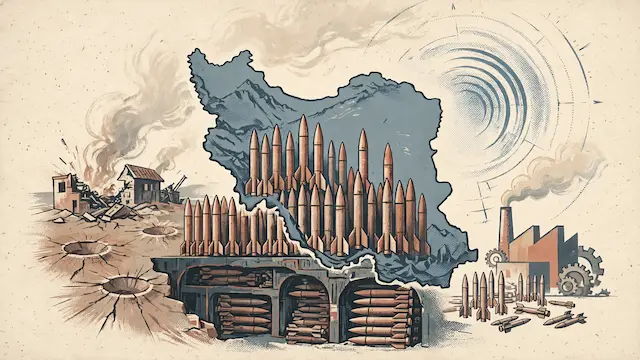
A Western intelligence assessment indicates that Iran has maintained a substantial military potential and is rebuilding its production capabilities, despite extensive attacks by the United States and Israel. The report reveals that Tehran currently possesses at least 1,700 ballistic missiles of various types. Iran's defense industry has reportedly restarted some assembly lines and is now producing approximately 50 new ballistic missiles monthly. While this production rate is about half of what it was before recent hostilities, it suggests Iran can replenish its arsenal and continue its armament efforts even if tensions escalate.
The intelligence findings contrast sharply with public statements from U.S. administration officials, who had claimed that airstrikes had nearly crippled Iran's production and irrevocably damaged its missile stockpiles. A Western source familiar with military reports told Bloomberg that the Iranian regime has managed to preserve a significant portion of its capabilities. The report also suggests Iran may still possess thousands of Shahed drones. During the recent conflict, Iran launched at least 2,200 ballistic missiles and over 4,900 Shahed drones, according to published data. The defense against these attacks required approximately 1,000 American Patriot interceptors, while the annual production rate for these interceptors is only about 650.
Three key factors are cited for the resilience of Iran's arms industry: a deep, decades-old underground infrastructure designed to withstand air attacks; widespread industrial dispersal, with missile production integrated into semi-civilian infrastructure and relying on pre-stocked components; and the preservation of knowledge and personnel, enabling the repair and reactivation of production lines even if damaged.
Satellite images from November showed extensive excavation and construction near two major missile bases, along with repairs at at least 12 military sites damaged by attacks. Analysts from the British intelligence firm MAIAR noted significant activity at the Garmadarreh base near Karaj and the Shahroud base in Semnan province.
In a previous interview, then-U.S. President Donald Trump stated that the survival of the current Iranian regime until the end of his term would be a personal defeat, and he would not hesitate to use military force to prevent Iran from threatening U.S. allies. The figure of 1,700 remaining missiles, while not necessarily equating to 1,700 operational launches, is sufficient to influence the security calculations of Israel and regional nations. Earlier Israeli assessments suggested an initial stockpile of around 2,500 missiles, and the discrepancy between launched, remaining, and initial estimates is likely due to differing definitions, real-time production, and varying initial stock assessments.
Mentioned




