
US Air Traffic System Failure Halts Flights, Affecting Thousands
Translated & summarized from Vesty by baba
A widespread system failure in U.S. air traffic control's radar and communication systems on November 14 caused an unprecedented nationwide grounding of flights, affecting nearly 17,000 flights. The Federal Aviation Administration (FAA) lifted the ban after four hours, but significant delays and cancellations persisted. Secretary of Transportation Sean Duffy attributed the issue to an overloaded, outdated communication system, while Secretary of Homeland Security Markwayne Mullin stated there was no evidence of a cyberattack. The incident has highlighted the need for urgent modernization of U.S. aviation infrastructure, prompting an increased funding request from the administration.
The story in 6 lines · by baba
- Nearly 17,000 flights were canceled or delayed in the U.S. due to a massive air traffic control system failure.
- The Federal Aviation Administration (FAA) grounded all flights for over four hours on November 14.
- Secretary of Transportation Sean Duffy cited an overloaded and outdated communication system as the cause.
- No evidence of a cyberattack was found, according to Secretary of Homeland Security Markwayne Mullin.
- The incident has renewed calls for significant upgrades to aging U.S. aviation infrastructure.
- The administration is requesting $50 billion for modernization, an increase from a previous $30.1 billion request.
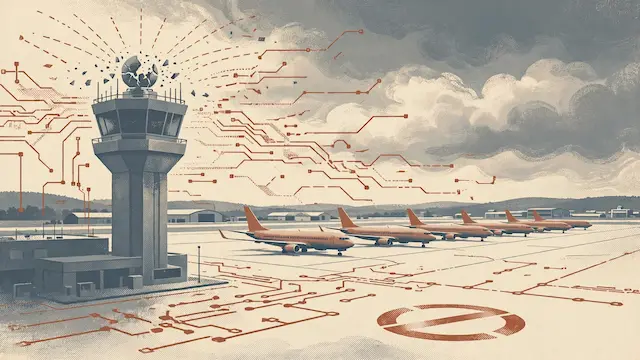
A major system failure in the U.S. air traffic control's radar and communication systems on Saturday, November 14, led to the unprecedented grounding of all flights nationwide. The Federal Aviation Administration (FAA) lifted the flight ban after more than four hours of disruption, around 3:30 AM Israeli time. This marks the most significant air traffic stoppage since January 2023. According to Flightradar24, over 6,600 flights were canceled and approximately 8,600 were delayed. Airlines also preemptively canceled about 1,500 flights scheduled for Sunday, November 15, anticipating ongoing effects.
U.S. Secretary of Transportation Sean Duffy explained that the air traffic control's outdated communication system became overloaded with data, causing it to transmit erroneous information. "Our switches and routers became overloaded with data. They started outputting inconsistent information, and that's why we shut the system down," Duffy stated. He confirmed the malfunction caused intermittent failures in communication and radar control systems, and the decision to halt flights was made for safety reasons. While the initial cause of the overload remains unknown, the administration emphasized there are no current indications of a cyberattack, though it is being investigated.
The disruption's impact extended beyond the U.S., affecting European and international flights. Eurocontrol, the European organization for air navigation safety, suspended flights to the U.S. at the FAA's request, impacting 42 member states. Flights departing the U.S., including those to Israel, were also affected. It was unclear at the time of reporting whether European restrictions had been lifted following the U.S. ban's cancellation.
An industry source told CNN that the malfunction simultaneously affected radar systems used by controllers and radio frequencies for pilot communication across different parts of the country. The uncertainty surrounding the cause and scope of the problem prompted the emergency decision to halt all departures. The ban, effective Friday at 3:54 PM New York time (10:54 PM Israeli time), was issued due to "exceptional circumstances and safety considerations." While departing flights were grounded, aircraft already in the air were permitted to continue their journeys. International flights bound for the U.S. were handled on a case-by-case basis.
At the time the ban was announced, over 4,000 aircraft were airborne, en route to U.S. airports, according to Flightradar24. Hundreds of flights were rerouted, with Cirium data indicating at least 827 flights diverted, 670 returning to their origin airports and 157 sent to alternative destinations. Major airports experienced significant passenger backlogs and widespread delays and cancellations. Secretary Duffy confirmed that all 22 regional air traffic control centers were affected. Secretary of Homeland Security Markwayne Mullin sought to reassure the public, stating there was no evidence of a malicious attack and that the situation was a communication failure. He assured that President Trump was informed and that passengers already in the air were safe, drawing a distinction from the 9/11 attacks. Aviation experts warned that restoring normal schedules could take considerably longer than the grounding itself, due to cascading effects on aircraft and crew positioning.
The incident has renewed scrutiny of the U.S. aviation infrastructure, much of which relies on decades-old equipment. Previous malfunctions, including one involving a copper cable at Newark Liberty International Airport and another affecting communication infrastructure in Philadelphia in September, have caused significant disruptions and staff stress. The FAA still uses computers that are decades old, with spare parts sometimes sourced from online auctions. The agency announced plans to replace old floppy disk drives used for meteorological data transmission by the end of 2028. While 68% of outdated copper cable infrastructure has reportedly been replaced with fiber optics, significant upgrades are still needed.
Initial speculation about a potential link to a new artificial intelligence system called SMART, recently expanded for air traffic management, was dismissed by the FAA and the system's developer, AirSpace Intel. SMART analyzes data but does not directly control aircraft or communication systems. The last nationwide flight stoppage occurred in January 2023 due to a NOTAM system failure, lasting less than two hours. The only other nationwide grounding was after the September 11, 2001, terrorist attacks.
Following the recent failure, the Trump administration announced an increased funding request of $50 billion for modernizing the U.S. air traffic control system, up from an earlier request of $30.1 billion. This follows a previously approved five-year, $12.5 billion program. The increased funding is intended to replace outdated infrastructure, upgrade hardware and software, and create a more resilient system. The incident has intensified pressure on Congress to approve the necessary funding, with major airlines supporting the administration's request.
Mentioned
The same event, reported separately by each outlet. Open a few to compare what different newsrooms emphasize — and what they leave out.
Centre 3Arab 1Other 2







Not the same event — other stories that share this one’s people, places, or theme: background, reactions, and follow-ups.
