
Eisenkot Bloc Explores Halting Haredi Draft Enforcement to Secure Religious Party Support
Translated & summarized from Al-Shams by baba
Gadi Eisenkot's Change bloc is proposing to freeze enforcement of mandatory military conscription and arrest of draft dodgers for one year to gain support from Haredi parties for a new government. This plan faces significant legal challenges from the Supreme Court and opposition from the military. Meanwhile, Benjamin Netanyahu is attempting to keep Haredi parties from joining Eisenkot's bloc, while Avigdor Lieberman's stance on potential Arab party support complicates coalition building.
The story in 5 lines · by baba
- Gadi Eisenkot's bloc is considering a one-year freeze on Haredi draft enforcement to secure religious party support.
- The proposal aims to allow time for a new legal framework for Haredi conscription.
- The plan faces legal challenges from the Supreme Court and opposition from the IDF.
- Benjamin Netanyahu is working to prevent Haredi parties from joining Eisenkot's coalition.
- Avigdor Lieberman's opposition to governments relying on Arab party support complicates coalition talks.
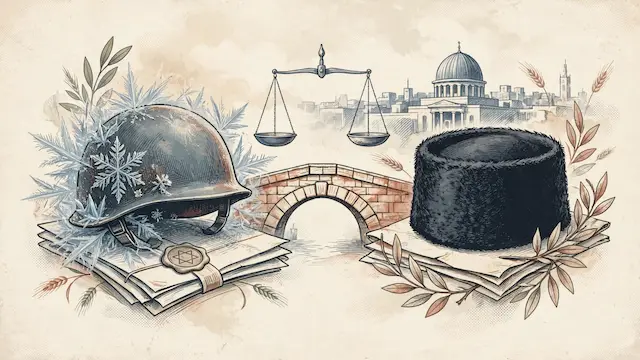
The Israeli Change bloc, led by Gadi Eisenkot, is considering a political compromise with Haredi parties that would freeze mandatory conscription enforcement and the arrest of draft dodgers for up to a year. This move aims to secure their support or abstention in forming a new government. The proposal involves government assurances to suspend conscription enforcement measures during the first year of the government's term, using the period to find a mutually agreed legal framework for drafting yeshiva students. This would allow for a political agreement without immediately resolving the sensitive conscription issue.
These efforts follow Avigdor Lieberman, head of the Yisrael Beiteinu party, dropping his objections to certain moves by the Change bloc, facilitating intensified contacts with Haredi parties, particularly United Torah Judaism, whose stance is seen as crucial for Eisenkot's government prospects. The bloc faces a dilemma: it cannot pass a new conscription law satisfying Haredi demands before forming a government, prompting consideration of a temporary freeze on prosecutions and arrests in exchange for political backing.
However, the proposal faces significant legal and political hurdles. The Israeli Supreme Court has previously rejected government authority to freeze conscription enforcement without a legal basis. The court has also ruled against the continued exemption of Haredim from military service, making any government decision to suspend enforcement vulnerable to legal challenges. The military establishment also has reservations, with the IDF opposing a blanket freeze on arrests, viewing enforcement measures as essential for ensuring and maintaining equal application of military service law.
Legal challenges are not the only obstacles. It is estimated that United Torah Judaism might be more open to negotiations with Eisenkot, potentially excluding the Shas party led by Aryeh Deri for now. Meanwhile, Benjamin Netanyahu is actively working to prevent Haredi parties from joining the Change bloc, engaging them in talks and arguing that a government led by Eisenkot, possibly reliant on Arab parties, would not secure their demands. Lieberman's position also presents a complication, as he opposes participating in a government supported by the United Arab List (Ra'am), despite his past opposition to Haredi draft exemptions.
Eisenkot is thus navigating a complex political equation: appeasing Haredi parties without alienating Lieberman, whose primary goal is to end Netanyahu's premiership. While a one-year freeze on draft enforcement might benefit United Torah Judaism, its success depends on its ability to withstand legal and political scrutiny. The Haredi draft issue is a major point of contention in Israeli politics, with the Haredi community insisting on exemptions for yeshiva students while public pressure mounts for broader conscription. The expiration of the legal framework for exemptions has intensified the debate, with the Supreme Court emphasizing the need for Haredim to comply with military service law.
Mentioned




