
Real Estate Developer Offers Decade-Long Payment Deferral Amidst Market Slowdown
Translated & summarized from TheMarker by baba
Gindi Holdings is offering a decade-long, interest-free deferral on a NIS 900,000 payment for new apartments to combat a slowdown in sales. Experts question if this creative marketing tactic addresses the fundamental issue of affordability, as prices have recently shown a slight decline. The article argues that the real problem is the gap between property prices and consumer income, predicting further price drops and urging government action on land release and infrastructure to create a healthier market.
The story in 5 lines · by baba
- Gindi Holdings offers a decade-long, interest-free deferral on a NIS 900,000 payment for new apartments.
- Recent data shows a 1.8% decrease in Israeli apartment prices in July-August 2026.
- The average monthly mortgage payment for a four-room apartment exceeds NIS 10,800.
- Experts predict continued apartment price declines over the next five years.
- The article calls for government action on land release and infrastructure to address affordability.
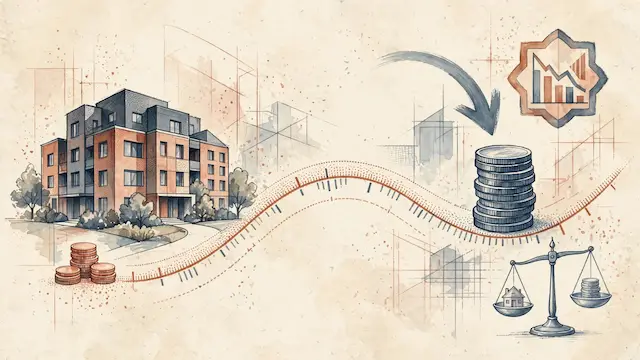
Gindi Holdings has launched a new marketing initiative offering buyers the ability to defer a NIS 900,000 payment for ten years after receiving their apartment keys, with no interest or linkage. This creative approach aims to make high property prices seem more manageable, but questions remain about whether it truly solves affordability issues or merely postpones the financial burden.
While the interest-free, linkage-free deferral is a significant financial benefit, it does not eliminate the debt. The banking supervisor has previously warned about the risks associated with financing and payment deferral schemes. The article suggests that the Israeli real estate market operates on an assumption that prices will always rise, viewing any downturn as temporary. However, recent data from the Central Bureau of Statistics shows a 1.8% decrease in apartment prices in July-August 2026 compared to the previous year, indicating that prices do not always follow market slogans.
The core problem, according to the author, is not a lack of marketing ideas but the gap between asking prices and consumers' ability to pay. The average monthly mortgage payment for a typical four-room apartment in 12 surveyed cities, financed at 70% over 25 years, was NIS 10,864 in the second quarter of 2026, even after the buyer provided a down payment. Marketing campaigns cannot increase a customer's salary, and the reliance on future salary increases is a gamble.
Doron Nir, a marketing director and business consultant, argues that marketing should not just overcome objections but also identify when they are justified. He believes customers often need financing solutions rather than decade-long payment deferrals. Nir predicts that apartment prices will continue to fall over the next five years, moving away from the accustomed price increases. He hopes this trend will make apartments a product for living rather than an entry barrier for the wealthy.
To foster a healthier market, the government needs to focus on more than just financing. This includes releasing more land for construction, streamlining urban licensing procedures, and investing in infrastructure. The author emphasizes that approved plans do not equate to finished apartments without supporting infrastructure. Additionally, industrial and innovative construction methods could reduce costs and timelines, coupled with reliable public transportation connecting peripheral areas to employment centers. Without essential services and accessibility, new developments in the periphery are not a viable alternative to living in central areas. Until these issues are addressed, the market will continue to confuse successful promotions with market health, and the underlying problem of unaffordability will persist.
The same event, reported separately by each outlet. Open a few to compare what different newsrooms emphasize — and what they leave out.
Other 2

Not the same event — other stories that share this one’s people, places, or theme: background, reactions, and follow-ups.
