
Israel's Economy Poised for Record Growth, Surpassing Sweden and UAE
Translated & summarized from Cursorinfo by baba
Israel's economy is projected to experience record growth, with the IMF forecasting its GDP to reach $747 billion by 2026, moving it to 25th globally. S&P has raised its growth outlook to 5.5% for 2026 and 7% for 2027. This expansion, partly driven by the strengthening shekel and the tech sector, is expected to surpass economies like Sweden and the UAE. However, ongoing security threats continue to impact Israel's credit rating and potential for improved living standards.
The story in 6 lines · by baba
- Israel's GDP is projected to hit $747 billion by 2026, ranking it 25th globally, according to the IMF.
- S&P forecasts Israel's economy to grow by 5.5% in 2026 and 7% in 2027.
- Economic growth is partly attributed to the strengthening Israeli shekel and the expansion of tech giant Nvidia.
- Israel is expected to surpass Sweden, Ireland, Singapore, and the UAE in nominal economic size.
- Ongoing security threats continue to be a major factor affecting Israel's credit rating and economic potential.
- Increased GDP does not automatically translate to improved living standards for citizens.
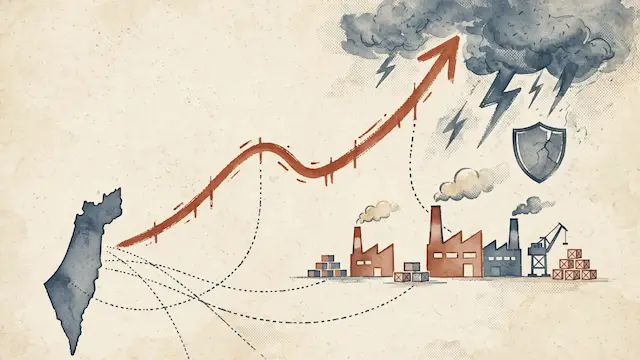
New forecasts from the International Monetary Fund (IMF) and S&P indicate a rapid expansion of Israel's economy, potentially exceeding current expectations and setting a new record for Gross Domestic Product (GDP) by the end of 2026. This growth could elevate Israel's global economic ranking by two positions. Despite ongoing military operations and security threats, the IMF projects Israel's GDP to reach $747 billion, placing it among the world's top 25 economies. According to the IMF's updated estimates, Israel will climb from 27th place in 2025 to 25th, surpassing several high-income nations. This projected GDP of $747 billion represents a significant increase from approximately $617 billion last year, a rise of about 21% in dollar terms. This expansion is expected to allow Israel to overtake Sweden, Ireland, Singapore, and the United Arab Emirates in nominal economic size.
However, the 21% increase in dollar terms does not solely reflect growth in the production of goods and services. A substantial factor is the strengthening of the Israeli shekel against the U.S. dollar, which automatically inflates the nominal GDP when converted. Therefore, actual economic growth rates need to be assessed independently of currency fluctuations.
International rating agency S&P also presented positive assessments, raising its growth forecast for Israel's economy to approximately 5.5% for 2026 and 7% for 2027. These figures are notably higher than projections for many developed countries, with significant acceleration anticipated next year due to a rebound in business activity. S&P analysts believe Israel's fundamental economic indicators remain strong, suggesting the country could achieve a higher sovereign credit rating if not for security threats. Currently, S&P has not altered Israel's rating or outlook, citing geopolitical risks related to confrontations with Iran and its proxies as major impediments. The agency estimates these security threats effectively lower Israel's potential credit rating by two notches, indicating that economic growth alone cannot fully offset the impact of regional instability.
The growth of U.S. tech giant Nvidia in Israel is identified as a key contributor to the economic expansion. Following its 2020 acquisition of Mellanox, Nvidia has expanded its research and engineering centers in Israel, developing technologies for global markets in areas like AI and data centers. While some production occurs abroad, the value of domestic research and development activities is factored into Israel's GDP. S&P draws a parallel between Nvidia's impact in Israel and that of international tech corporations in Ireland, noting that such presence significantly influences macroeconomic indicators. However, S&P emphasizes that Israel's tech sector also possesses a substantial indigenous research and production base, making the domestically generated economic value a crucial component of its national economy.
Despite optimistic forecasts, the projected rise in Israel's global economic standing does not automatically guarantee an improved standard of living for its citizens. Nominal GDP increases in dollar terms do not directly reflect citizens' purchasing power. Real income, inflation, and the cost of living are essential for assessing living standards. Furthermore, the distribution of economic gains among different population segments is critical. Government defense spending, necessitated by ongoing conflicts, diverts resources that could otherwise support economic needs. Persistent security threats also influence international investor decisions and borrowing costs, which is why rating agencies continue to factor in security risks despite positive economic outlooks. Nevertheless, the IMF and S&P assessments highlight the significant potential of the Israeli economy, driven by its technology sector, international investment, and recovering business activity.
The same event, reported separately by each outlet. Open a few to compare what different newsrooms emphasize — and what they leave out.
Centre 1Other 2


Not the same event — other stories that share this one’s people, places, or theme: background, reactions, and follow-ups.

