
S&P: Israel's Growth Boosted by Overseas Production, Security Risks Remain
Translated & summarized from Maariv by baba
Credit rating agency S&P has raised Israel's growth forecast to 5.5% this year and 7% in 2027, but noted that a significant part of this increase stems from the inclusion of overseas production by Israeli companies. The agency maintains a stable outlook, assuming military conflicts remain contained despite ongoing tensions with Iran. Security risks have had a limited impact on the economy so far, partly due to the strong high-tech sector and remote work capabilities. S&P warns that operating without an approved budget and potential reductions in U.S. aid could pose future challenges.
The story in 6 lines · by baba
- S&P raised Israel's growth forecast to 5.5% this year and 7% in 2027.
- A portion of Israel's projected growth is due to including overseas production by companies like Mellanox.
- S&P's stable outlook assumes military conflicts will remain contained despite Iran tensions.
- Security risks have had a limited impact on Israel's economy so far.
- Israel may enter 2027 without an approved budget, operating under an extension.
- Defense spending is expected to exceed 7% of GDP this year.
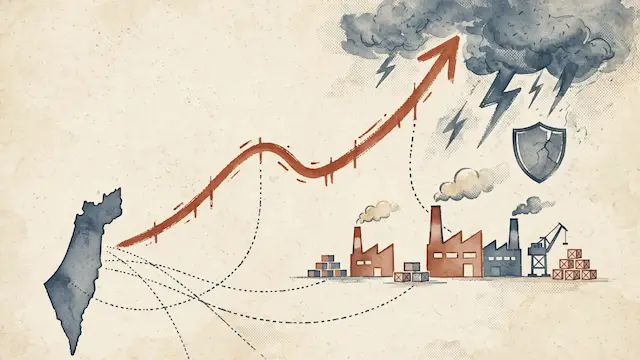
Credit rating agency S&P has raised its growth forecast for Israel, projecting 5.5% for the current year and 7% for 2027. However, a significant portion of this projected growth is attributed to a change in how the Gross Domestic Product (GDP) is calculated, now including the overseas production of Israeli companies like Mellanox, which was acquired by Nvidia. This accounting adjustment means that a portion of the reported GDP increase does not directly translate into improved household income, as the production does not utilize local labor or capital and the revenue largely bypasses Israeli residents.
S&P noted that in the second quarter, exports produced abroad accounted for 5.8% of Israel's GDP, a substantial rise from 1.7% in 2023. The agency compared this situation to Ireland, where global tech and pharmaceutical companies inflate GDP by over 60%, though in Israel's case, the discrepancy is about 6% and is linked to domestically developed intellectual property and technology.
Despite the economic outlook, S&P maintains a stable outlook, predicated on the assumption that further military confrontations will remain contained, even with ongoing tensions with Iran and its proxies. The agency's baseline scenario anticipates continued regional conflict and associated supply and energy disruptions through 2027. While acknowledging potential for further missile and drone exchanges, S&P highlighted that diplomatic channels remain open.
Security risks have so far had a limited impact on public behavior, with no significant instability in bank deposits or foreign currency exchanges. S&P attributes this resilience to the strong performance of the high-tech export sector and the widespread ability of employees to work remotely, which have mitigated the impact on economic activity.
Looking ahead, S&P anticipates Israel will enter 2027 without an approved budget, operating under an extension, which could delay decisions on taxes, expenditures, and reforms. Defense spending is expected to exceed 7% of GDP this year and remain above pre-2023 levels. A potential gradual reduction in U.S. military aid is also cited as a future source of budgetary pressure. Conversely, Israel's favorable debt structure, deep capital markets, and foreign exchange reserves are seen as strengths. An upgrade could occur if growth and fiscal outcomes significantly exceed expectations or if security risks decrease substantially and persistently. Conversely, a marked weakening in economic or fiscal performance beyond projections could lead to a negative rating action.
The same event, reported separately by each outlet. Open a few to compare what different newsrooms emphasize — and what they leave out.
Centre 1Other 1

Not the same event — other stories that share this one’s people, places, or theme: background, reactions, and follow-ups.