
Israel Strikes Southern Lebanon with Airstrikes and Artillery
Translated & summarized from Arab48 by baba
The Israeli military launched airstrikes and artillery shelling on several towns in southern Lebanon on Tuesday, escalating ongoing attacks despite de-escalation efforts. Lebanese media reported multiple strikes targeting towns and their outskirts, including a drone strike. Lebanese President Joseph Aoun called for respecting international law and halting Israeli aggressions, while Prime Minister Nawaf Salam warned of renewed war. The situation remains tense due to border disputes and Hezbollah's disarmament demands.
The story in 5 lines · by baba
- Israeli military conducted airstrikes and artillery shelling on southern Lebanese towns on Tuesday.
- Lebanese President Joseph Aoun urged respect for international law and a halt to Israeli aggressions.
- Prime Minister Nawaf Salam warned of the risks of renewed war and further Israeli occupation.
- The attacks occurred despite declared understandings aimed at de-escalation.
- The security situation is complicated by border disputes and Hezbollah disarmament demands.
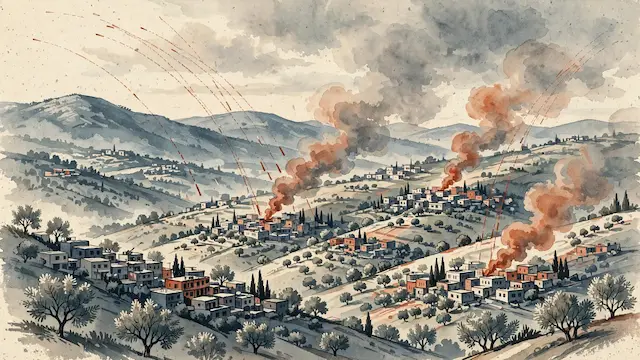
The Israeli military escalated its attacks on southern Lebanese towns on Tuesday, conducting a series of airstrikes and artillery shelling across several areas. These actions are part of ongoing aggressions against Lebanese territory, despite declared understandings aimed at de-escalation. Lebanese media reported that Israeli warplanes carried out two airstrikes on the towns of Kfar Tebnit and Al-Qantara, while other raids targeted the outskirts of Bani Hayyan, Markaba, and Al-Jarmaq. An Israeli drone also launched a guided missile strike on the outskirts of Al-Jarmaq. Artillery shelling extended to the valley of Zebqine and the outskirts of Al-Mansouri, as well as the outskirts of Zawtar Al-Sharqiyeh and Mefdoum. Concurrently, the Israeli army conducted a detonation on Tel Al-Shariqa, north of Khiyam. These attacks occur amid continued Israeli military operations in southern Lebanon, which include airstrikes, artillery shelling, demolitions, and targeting of homes and agricultural lands. This raises concerns about a potential expansion of confrontations and a renewed war, exacerbating the suffering of residents in border areas. Politically, the developments coincide with stalled Lebanese-Israeli negotiation efforts, which have been on hold since the Florida meeting. Meanwhile, American-Iranian negotiations continue with the aim of ending the war, with anticipation surrounding the potential repercussions of any agreement between Washington and Tehran on the situation in Lebanon. In this context, Lebanese President Joseph Aoun emphasized the necessity of respecting international humanitarian law, halting Israeli aggressions, and creating suitable conditions for the safe return of southern residents to their villages and homes to resume normal life. Prime Minister Nawaf Salam warned of the dangers of returning to war, urging avoidance of entanglements that could drag Lebanon back into conflicts. He stated that continued hostilities would only provide Israel with more pretexts to expand its occupation of the south and continue destruction, killing, and displacement. The security situation in the south remains contingent on disagreements over border arrangements and the region's future. Lebanon insists on an Israeli withdrawal from occupied territories, while Israel demands the disarmament of Hezbollah, leaving the political and security path facing intertwined challenges. In August 2026, the United Nations documented Israeli violations of Lebanese airspace and territory, including the launch of hundreds of projectiles towards the south, indicating the fragility of the security situation and the ongoing breaches of understandings aimed at maintaining calm.
Mentioned
The same event, reported separately by each outlet. Open a few to compare what different newsrooms emphasize — and what they leave out.
Arab 2

Not the same event — other stories that share this one’s people, places, or theme: background, reactions, and follow-ups.
