
Near-Death Visions Linked to Space Shape and Color, Study Finds
Translated & summarized from Cursorinfo by baba
University of Haifa researchers found a link between the shape of space and color in near-death experiences. Participants drawing their recollections showed tunnel-like visions were often achromatic, while wide, curved spaces were typically colorful. The study, involving 50 individuals, suggests potential connections to physiological phenomena like tunnel vision and the Ganzfeld effect, though limitations include sample size and potential memory distortion.
The story in 5 lines · by baba
- University of Haifa researchers linked near-death experience space shapes to colors in a new study.
- Tunnel-like visions were predominantly achromatic, while wide, curved spaces were often colorful.
- The study involved 50 participants who drew their near-death recollections.
- Findings may relate to physiological effects like tunnel vision and the Ganzfeld effect.
- Researchers acknowledge limitations including sample size and potential memory distortion.
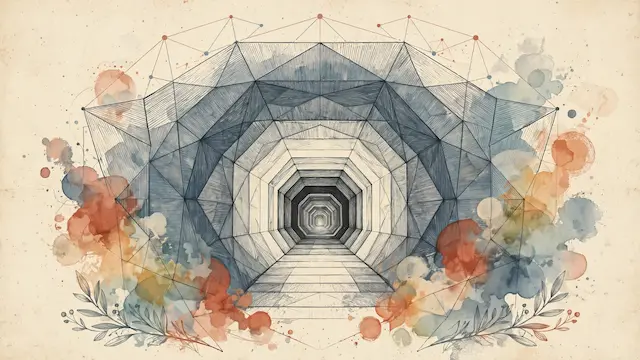
Researchers at the University of Haifa have discovered a connection between the perceived shape of space and the colors experienced during near-death experiences. The study, published by ScienceAlert, involved 50 individuals who had undergone clinical death. These participants were asked to draw their recollections, detailing the shape of space, their position within it, direction of movement, and colors.
The project was led by Frans Lerner, a researcher of neuro-phenomenology at the University of Haifa. Lerner hypothesized that drawings could reveal patterns missed in verbal accounts, leading the team to use visual mapping instead of traditional questionnaires. The drawings revealed four recurring spatial structures: conical, tunnel-like spaces; wide, curved arch-like spaces; flat, gently curved planes; and encompassing, spherical or oval spaces.
Analysis showed a significant correlation between space shape and color. Of the 28 conical spaces depicted, 22 were achromatic (black, white, gray, or colorless light). In contrast, 27 out of 31 wide, curved spaces were described as colorful. The other two categories showed a mix of colored and colorless experiences.
The researchers suggest the achromatic tunnel visions might relate to tunnel vision caused by oxygen deprivation, where the visual field narrows. The prevalence of black and white also resembles the eye's response to low light, relying on brightness-sensitive cells. Some encompassing spaces were likened to the Ganzfeld effect, experienced when viewing a uniform, featureless light field.
While the study highlights a novel area of research into the spatial and color aspects of near-death experiences, the authors acknowledge limitations. The sample size was small, participants' memories might be distorted, and the drawing prompts could have influenced responses. Further research is needed to explore the underlying mechanisms and compare these experiences with other altered states of consciousness.