
Israel Faces Drone Threat Amid Security Gaps
Translated & summarized from Haaretz by baba
Prime Minister Benjamin Netanyahu has highlighted drones as a major security threat to Israel, with protective measures reportedly being installed at his homes. Experts warn that Israel is unprepared for a surprise drone attack launched from within its borders, citing vulnerabilities at critical infrastructure and military bases. Despite recent efforts to bolster border defenses and a temporary ban on certain drone types, significant gaps in detection, interception, and regulation persist.
The story in 6 lines · by baba
- Prime Minister Netanyahu identified drones as Israel's second-biggest security threat after nuclear weapons.
- Experts believe Israel is unprepared for a surprise drone attack launched from within its borders.
- Protective measures against drones are reportedly being installed at Netanyahu's private residences.
- Ukraine's "Spider Web" drone attack and Israel's similar operation in Iran are cited as precedents.
- Defense Minister Israel Katz has banned fiber optic and cellular-controlled drones for six months.
- Significant technological, operational, and regulatory gaps remain in Israel's drone defense.
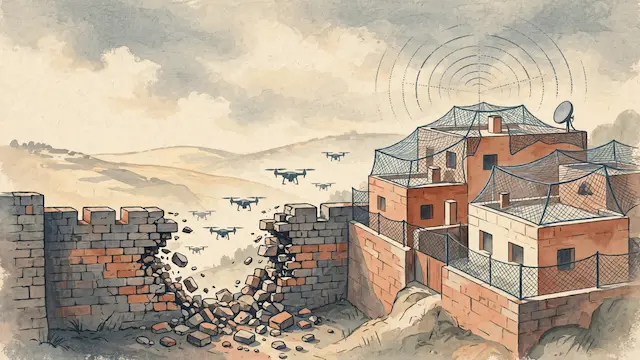
Prime Minister Benjamin Netanyahu has identified drone threats as a primary security concern for Israel, second only to nuclear weapons, following the October 7th attacks. He stated that drones "disperse the ability to harm you to any entity" and can be used by enemies to target critical infrastructure, communication hubs, command centers, and leadership. Netanyahu also revealed that protective measures against drones are being installed around his private residences in Jerusalem and Caesarea.
The article draws parallels to Ukraine's "Spider Web" operation in October 2023, where over a hundred explosive-laden drones were covertly infiltrated into Russia and struck strategic targets, including forty Russian strategic bombers. Israel reportedly employed similar tactics against Iran in "Operation All the King's Men," smuggling drone components into the country for attacks on air defense and ballistic missile batteries.
Despite these incidents and growing global awareness of drone warfare, experts and officials interviewed by Haaretz indicate that Israel is currently unprepared for a surprise drone attack launched from within its borders. Potential targets include Ben Gurion Airport, air force bases, government buildings, power stations, and crowded stadiums. The accessibility and low cost of drones, including advanced FPV (First Person View) models, make them a significant threat, often referred to as an "air force for the poor."
While efforts are underway to counter the drone threat, including the recent deployment of Brigade Control Complexes (MABAT) along borders to monitor low-altitude airspace, significant gaps remain. These include technological, operational, and regulatory deficiencies. Experts emphasize the need for a multi-layered defense system involving advanced sensors, interception methods, and passive protection for sensitive sites, noting that a comprehensive defense for the entire country is not feasible. The article also highlights the challenge of distinguishing between civilian and hostile drones, referencing a failed attempt to implement mandatory transponders for civilian drones after the October 7th attacks.
In response to the escalating threat, Defense Minister Israel Katz recently banned the use of drones controlled by fiber optics or cellular communication for six months, citing intelligence about increasing threats from internal and external enemies, including criminal organizations. However, the effectiveness of this ban is questioned due to the lack of a comprehensive monitoring system for authorized drone flights.
Mentioned

