
US Midterms Signal New Existential Challenge for Israel, US, Europe
Translated & summarized from Maariv by baba
The US midterm election results signal a new existential challenge for Israel, the US, and Europe, framing the current global situation as a geostrategic clash of civilizations. An analysis by Amit Yagor describes two opposing blocs: the "Old Order Civilization" (Russia, China, Iran, Turkey, Qatar) and the "New Order Civilization" (US, Israel, India, UAE, etc.). The article claims that the "Old Order" uses groups like the Muslim Brotherhood to disrupt Western leadership and foster skepticism. It urges Israel and the US to decisively confront this threat through both military and civilian efforts, including public and emotional campaigns, to avoid severe national security consequences.
The story in 6 lines · by baba
- US midterm election results present a new existential challenge for Israel, the US, and Europe.
- The global landscape is characterized as a geostrategic clash of civilizations, not just local politics.
- Two blocs are identified: the "Old Order Civilization" (Russia, China, Iran, Turkey, Qatar) and the "New Order Civilization" (US, Israel, India, UAE, etc.).
- The "Old Order" allegedly uses groups like the Muslim Brotherhood to disrupt Western leadership and sow doubt.
- Hesitation in confronting this threat comes at a high cost, potentially leading to existential national security issues.
- Israel and the US are urged to combine decisive military action with strong civilian and emotional campaigns.
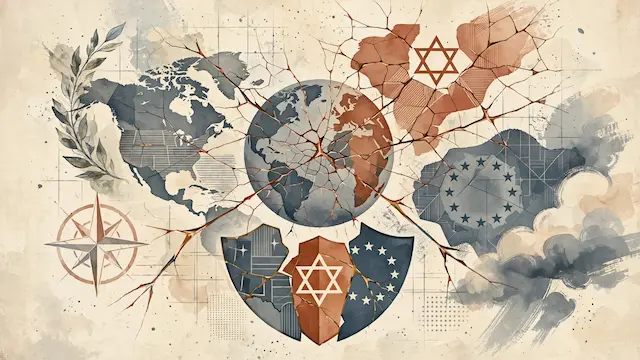
The results of the US midterm elections are presenting a new existential challenge for Israel, the United States, and Europe, according to an analysis by Amit Yagor. The current global landscape is described not as a local political debate, but as a geostrategic clash of civilizations and a modern iteration of religious wars. While the Middle East was once considered the primary friction point, the arena has now shifted to Europe and the US.
The analysis posits that hesitation in confronting this challenge comes at a high cost. It suggests that Iran, Turkey, and Qatar, along with their proxies like the Muslim Brotherhood, in cooperation with Russia and China, are actively working to thwart former President Donald Trump's vision. Historically, the president's party tends to lose in midterm elections.
The author argues that the global stage is witnessing a conflict between two distinct blocs: the "Old Order Civilization," comprising powers like Russia and China, alongside Iran, Pakistan, Turkey, and Qatar, and the "New Order Civilization," which includes the US, Israel, India, the UAE, Jordan, Greece, Cyprus, and others. The article claims that disturbances in European cities and potential unrest in the US and Israel are orchestrated, funded, and timed actions by the Muslim Brotherhood, serving as the "Old Order" bloc's front-line forces.
According to the analysis, the "Old Order" aims to disrupt leadership, alter public perception of US military and economic actions, and foster skepticism and retreat. The article suggests that the halt of military campaigns against Iran before a decisive victory, due to pressure from the "Old Order," allowed Tehran breathing room to influence Western affairs. The core strategy, it claims, is to initiate conflict, gain a significant advantage, and then cease operations, allowing the surviving adversary to exact a price.
To counter this trend, the article urges Israel to act decisively on two parallel fronts: employing powerful emotional narratives, shared values, human stories, and highlighting the common threat of Islamic terror, rather than relying solely on academic explanations or legal arguments. It concludes that if Israel and the US do not achieve decisive outcomes against the "Old Order Civilization" and integrate civilian efforts alongside military ones, including domestic action against the Muslim Brotherhood, they will face existential national security costs. A combination of a determined military approach to overthrow the Iranian regime and a robust public, civilian, and emotional campaign in the US is presented as the only way to break this worrying trend, exemplified by the US midterm election results and subsequent reactions.
Mentioned




