
US Midterms Reveal Deep Societal Divide, Impacting Israel's Foreign Policy
Translated & summarized from Ynet by baba
US midterm elections revealed a deep societal and economic divide, leading to a historic defeat for the incumbent party and the loss of control over Congress. This outcome, fueled by broken economic promises and foreign policy entanglements, particularly the conflict with Iran, has isolated the US and impacted its allies. The article argues Israel must re-evaluate its foreign policy towards Washington, focusing on building new alliances with emerging American communities and adapting to the country's changing demographics.
The story in 6 lines · by baba
- US midterms exposed a deep societal and economic schism, leading to a historic loss of congressional control.
- The traditional American social contract, promising upward mobility through education and hard work, has been broken.
- Radical left and right movements exploit economic anxieties, with both targeting the Washington establishment.
- Escalation of the Iran conflict and trade policies created an economic crisis, contributing to the electoral defeat.
- The US found itself isolated during the Iran crisis, with Israel as its sole active partner.
- Israel faces a warning to adapt its foreign policy to America's changing demographics and political landscape.
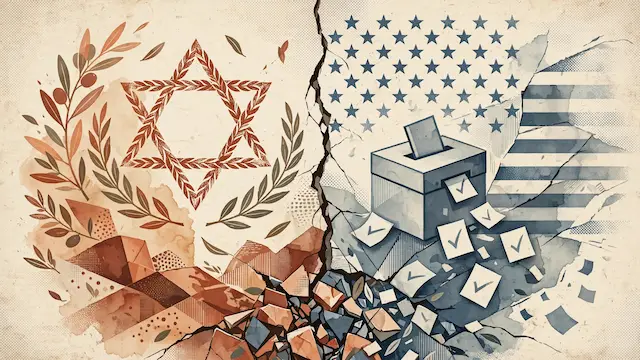
The recent US midterm elections in November 2026 signal a profound societal and economic schism, rather than a typical political pendulum swing. This divide, deeply rooted across generations and structures, is undermining the foundations of the American republic. The traditional social contract, where hard work and education led to upward mobility, has been broken for Generation Z. Soaring housing prices, overwhelming student debt, and the looming threat of AI and mass layoffs have trapped young Americans, stifling their economic future.
This disillusionment fuels radical political movements. On the progressive left, groups like the Democratic Socialists of America (DSA) advocate for classic class warfare solutions, including nationalization and seizing the means of production from corporate capitalism. Conversely, the right-wing 'Groypers' and the alt-right channel anxiety into nativist and xenophobic rhetoric, blaming foreigners, particularly skilled workers on H-1B visas, for job displacement.
A surprising convergence exists between these seemingly opposing factions: both identify the old Washington establishment as the primary enemy. They perceive a political system detached from citizen struggles, pouring billions into overseas projects and endless foreign wars. This sentiment was amplified when former President Donald Trump, campaigning on an 'America First' platform, found himself escalating a military confrontation with Iran. The administration's initial belief that this would be a short, surgical operation proved false, as the conflict became a costly quagmire, triggering a global energy crisis.
The administration's foreign and trade policies faced significant limitations. Disruptions to oil supplies from Russia due to the Ukraine war, coupled with Trump's tariffs on allies like Canada, Mexico, and the EU, created an economic trap. This economic strain, directly felt by ordinary Americans through rising costs for essentials like diesel and groceries, led to a political backlash. The disconnect between promises of prosperity and the reality of economic hardship contributed to a historic defeat for the incumbent party, resulting in the loss of control over both houses of Congress for the fifth time in US history.
This political upheaval has significant geopolitical implications, particularly for Israel. The US found itself isolated during the Iran crisis, with traditional allies refusing to join military coalitions or share the economic burden. Israel, under Prime Minister Benjamin Netanyahu, emerged as the sole active partner. This perception of Americans bearing the war's costs to support a controversial, solitary partnership damaged US influence. Traditional lobbying powerhouses like AIPAC faced challenges as a new generation of candidates rejected their funding, viewing disavowing Israel as a winning strategy for grassroots fundraising.
Israel's foreign policy, heavily reliant on the Republican party and its aging evangelical base, suffered a severe blow. The assumption that demographic shifts in America could be ignored proved to be strategic blindness. The article argues that Israel must redefine its approach to Washington, focusing on building alliances based on shared interests, similar to Menachem Begin's strategy with Christian Zionists. The new focus should be on cultivating relationships with growing, moderate Hispanic and African American communities who share values of family and community, and are uncomfortable with radical progressive discourse. Israel should engage these communities through civil, agricultural, and business collaborations, showcasing itself as a provider of solutions in water, health, and innovation. Furthermore, Israel needs to leverage social media by engaging micro-influencers and content creators from these communities to promote an authentic message. This midterm election outcome serves as a stark warning to Israel: failure to adapt to America's evolving political landscape and connect with its future generations could lead to unprecedented isolation.
Mentioned
The same event, reported separately by each outlet. Open a few to compare what different newsrooms emphasize — and what they leave out.
Left 1Centre 4Arab 1





Not the same event — other stories that share this one’s people, places, or theme: background, reactions, and follow-ups.



