
US Midterm Elections: Trump Faces Crucial Test Amid Economic Woes
Translated & summarized from Maariv by baba
The U.S. midterm elections, viewed as a critical test for Donald Trump, are nearing their end with over 51 million votes cast. Inflation and the high cost of living are major concerns for voters, impacting Trump's approval ratings negatively. Democrats are projected to gain control of the House of Representatives and have a strong chance of winning the Senate majority. The election also features complex dynamics involving Israel and accusations of antisemitism.
The story in 5 lines · by baba
- Over 51 million Americans have voted in the U.S. midterm elections, a key test for Donald Trump.
- Inflation and the cost of living are major issues, with Trump facing sharp criticism and low approval ratings.
- Democrats have a 92% chance of regaining the House of Representatives, with 237 projected seats.
- Democrats also have a 71% chance of securing a majority in the Senate.
- Campaign rhetoric linking Israel to local economic issues has drawn condemnation as antisemitic.
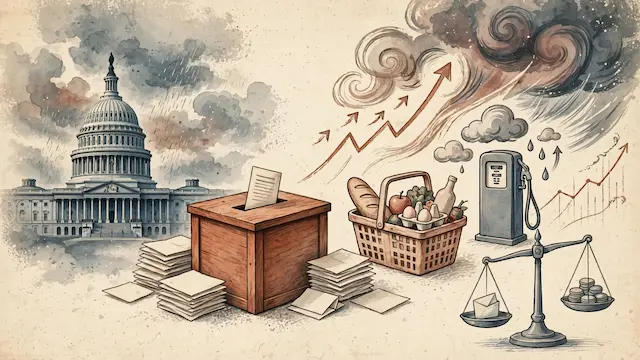
As over 51 million Americans have already cast their ballots, the U.S. midterm elections, seen as a referendum on former President Donald Trump, are nearing their conclusion. Key issues dominating the race include inflation and the cost of living, which have significantly impacted voter sentiment. Trump faces sharp criticism on economic matters, with his approval rating hitting a historic low of minus 52 points according to CNN.
The incumbent Congress also suffers from extremely low public trust, with an approval rating of only 14%, the lowest ever recorded before an election. These figures translate into a tangible advantage for the Democratic Party, which holds a 9% lead in the national congressional vote. This margin appears to negate the structural advantage Republicans gained from redistricting.
CNN's statistical models give the Democratic Party a 92% chance of regaining control of the House of Representatives, projecting 237 seats for Democrats compared to 198 for Republicans. The Senate race is more complex, but the momentum also favors Democrats, who have a 71% chance of securing a majority. Democrats are capitalizing on the unprecedented weakness of Republican candidates in traditionally conservative states.
The election's dynamics are further complicated by issues involving Israel and antisemitism. Jewish leaders, moderate politicians, and anti-defamation organizations have strongly condemned campaign rhetoric that links Jerusalem to grocery prices in Michigan, labeling it a clear antisemitic conspiracy. An early primary victory by El-Sied is seen by the Institute for National Security Studies as reflecting a leftward shift within the Democratic Party regarding Israel, a trend that could alienate moderate voters.
Mentioned
The same event, reported separately by each outlet. Open a few to compare what different newsrooms emphasize — and what they leave out.
Centre 1Other 1

Not the same event — other stories that share this one’s people, places, or theme: background, reactions, and follow-ups.



