
West Bank Olive Harvest Disrupted by Escalating Israeli Settler and Military Attacks
Translated & summarized from Arab48 by baba
Israeli settlers and soldiers carried out over 500 attacks during the West Bank's olive harvest season, significantly reducing olive oil production to an estimated 10,000-11,000 tons from a projected 21,000 tons. These actions, including crop theft and preventing farmers from accessing their lands, have led to cumulative losses exceeding $157 million since 2023. The report also details ongoing settlement expansion and calls from former Israeli security officials to designate the "Hilltop Youth" as a terrorist organization due to their alleged 13,000 attacks since October 7th.
The story in 6 lines · by baba
- Over 500 attacks by settlers and soldiers disrupted the West Bank olive harvest, leading to significant crop loss.
- Olive oil production is projected to drop to 10,000-11,000 tons, less than half the initial 21,000-ton estimate.
- Settler violence and military restrictions have caused cumulative direct losses to the olive sector exceeding $157 million since 2023.
- A rabbi's ruling permitted settlers to harvest Palestinian olives, citing religious interpretations of land ownership.
- Former Israeli security officials urged the government to label "Hilltop Youth" a terrorist group after thousands of attacks.
- Settlement expansion continues with new outposts and infrastructure development across the West Bank and Jerusalem.
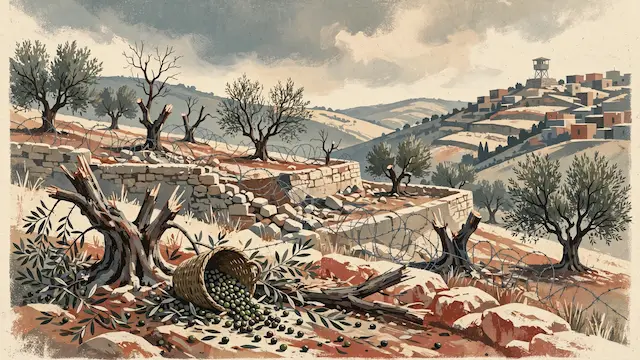
A report by the National Bureau for Defending Land and Resisting Settlements reveals a significant decline in the West Bank's olive oil production this season, attributed to a surge in attacks by Israeli settlers and soldiers. The report documented over 500 incidents since the harvest began, impacting around 200 Palestinian communities, with the most severe occurrences in the Jenin, Nablus, Salfit, and Ramallah governorates. In numerous locations, farmers were completely prevented from harvesting, and over 150 instances of crop theft were recorded. Nablus governorate saw the highest number of direct settler attacks, including tree vandalism and crop theft, depriving many villages of their harvest. The report also highlighted a religious ruling by Rabbi Dov Lior, issued on October 16, which permits settlers to harvest olives from Palestinian lands, based on interpretations claiming Jewish ownership. This ruling follows a pattern of similar religious justifications for seizing Palestinian property and crops, as seen in the book "Torat Hamelech" by Rabbis Yitzchak Shapira and Yosef Eliyatzur.
Palestinian Ministry of Agriculture estimates project olive oil production to fall between 10,000 and 11,000 tons, a sharp decrease from the initial forecast of 21,000 tons. Attacks and restricted access to lands, particularly those behind the separation barrier and near settlements, threaten nearly half the cultivated areas in several governorates. The Israeli military's decision to prohibit farmers from accessing "state lands" for harvesting, a new measure, and requiring prior coordination for access to private lands, further exacerbates the farmers' plight. Settler rhetoric, echoed by some Israeli military and government officials, frames Palestinian olive harvesting as incitement, used to justify restrictions on farmers and foreign solidarity activists. Some Israeli media outlets have noted a shift in how those opposing settler violence are portrayed, with solidarity activists now labeled as "anarchists."
The cumulative direct losses to the olive sector since 2023, due to tree destruction and access denial, are estimated to exceed $157 million. Beyond unharvested olives, significant quantities have been stolen and processed in settlement-owned facilities for sale under their own brands. The report also details ongoing settlement expansion activities across the West Bank, including the installation of mobile homes and continued land leveling near Jenin, the establishment of new outposts near Jericho and Al-Bireh, and extensive land confiscation and infrastructure development in the Hebron area. In Jerusalem, settlement projects aim to reshape the city's geography and isolate Palestinian neighborhoods, such as the planned 122 settlement units in Sheikh Jarrah.
Furthermore, former Israeli security officials have urged Prime Minister Binyamin Netanyahu to designate the "Hilltop Youth" group as a terrorist organization and halt government funding, citing approximately 13,000 attacks attributed to the group since October 7, 2023, resulting in 66 Palestinian deaths. The report concludes with a weekly summary of violations, including water line sabotage, attacks on olive harvesters, forced home demolitions, livestock theft, and obstruction of emergency services in various West Bank areas, alongside continued land confiscation and infrastructure development for settlements.
Mentioned
