
Secret 1956 Tripartite Pact on Suez Crisis Revealed
Translated & summarized from Cursorinfo by baba
In October 1956, Israel, France, and Britain signed the secret Sevres Protocol, agreeing to a coordinated military operation against Egypt during the Suez Crisis. The plan involved an Israeli invasion of Sinai as a pretext for British and French intervention. British Prime Minister Anthony Eden later ordered the destruction of the protocol to hide his country's prior involvement. The operation, known as the Suez War, was launched on October 29, 1956, but faced international condemnation and was ultimately halted, forcing a withdrawal.
The story in 6 lines · by baba
- Israel, France, and Britain secretly agreed to a joint military operation against Egypt in the Sevres Protocol of October 1956.
- The protocol outlined an Israeli invasion of Sinai to serve as a pretext for British and French intervention.
- British Prime Minister Anthony Eden ordered the destruction of the protocol to conceal his country's prior involvement.
- The coordinated action launched the Suez War on October 29, 1956.
- International condemnation from the US and USSR forced the three nations to cease hostilities and withdraw.
- The Sevres Protocol is a notable example of a secret military-political agreement in the Middle East.
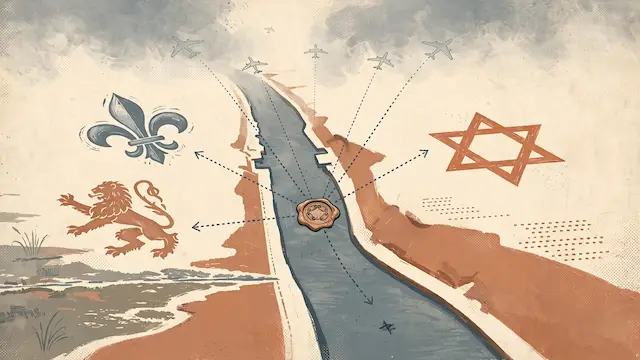
In October 1956, Israel, France, and Britain secretly agreed to a joint military operation against Egypt, detailed in a clandestine document known as the Sevres Protocol. The plan involved Israel launching an offensive into the Sinai Peninsula, which would then serve as a pretext for British and French forces to intervene.
The Suez Crisis, sparked by Egyptian President Gamal Abdel Nasser's nationalization of the Suez Canal in July 1956, prompted the alliance. The canal was vital for international trade and oil supply, and its seizure threatened British and French interests. Israel also had grievances with Egypt, including tensions, restrictions on shipping through the Strait of Tiran, and border clashes, aligning its objectives with those of Britain and France.
Negotiations for the protocol took place in Sevres, France, from October 22-24, 1956, with representatives including Israeli Prime Minister David Ben-Gurion, French Foreign Minister, and British representative Patrick Dean. The agreement stipulated that Israel would attack on October 29, advancing towards the Suez Canal. Subsequently, Britain and France would issue an ultimatum to both Israel and Egypt demanding troop withdrawal, while offering to temporarily station their own forces to protect shipping and separate the combatants. If Egypt refused, Britain and France would launch military action.
Upon learning of the protocol's existence, British Prime Minister Anthony Eden ordered the destruction of all copies to conceal Britain's prior involvement and present its actions as an independent response. Despite Eden's later denial in Parliament on December 20, 1956, of any prior knowledge of Israel's intentions or pre-existing agreements, the protocol's specific dates, actions, and commitments contradicted his statements.
The operation commenced on October 29, 1956, with Israel's Sinai offensive, followed by the British and French ultimatum and subsequent military actions. This led to the Suez War, also known as the Suez Crisis. However, the intervention faced strong international condemnation from the United States and the Soviet Union, forcing Britain, France, and Israel to cease hostilities and withdraw their forces under international pressure. The Sevres Protocol remains a significant historical example of secret military-political agreements in the Middle East.