
Fitch Warns Political Stalemate Threatens Israel's Credit Rating
Translated & summarized from Hamal by baba
International credit rating agency Fitch warned that Israel's political deadlock following the recent elections risks prolonged uncertainty and a caretaker government, potentially impacting its 'A' credit rating. The election results left no bloc with the 61 seats needed for a coalition, and Fitch anticipates a likely dissolution of the Knesset by January, leading to new elections in April. Failure to pass a budget by March 31st would trigger automatic dissolution, forcing austerity measures and limiting government spending.
The story in 5 lines · by baba
- Fitch warns Israel's political deadlock risks prolonged uncertainty and impacts its 'A' credit rating.
- Election results show no bloc secured the 61 seats required to form a stable coalition.
- A dissolution of the Knesset by January and new elections in April are considered likely.
- Failure to pass the state budget by March 31st would automatically dissolve the Knesset.
- Forced austerity measures and limited government spending are expected if no budget is approved.
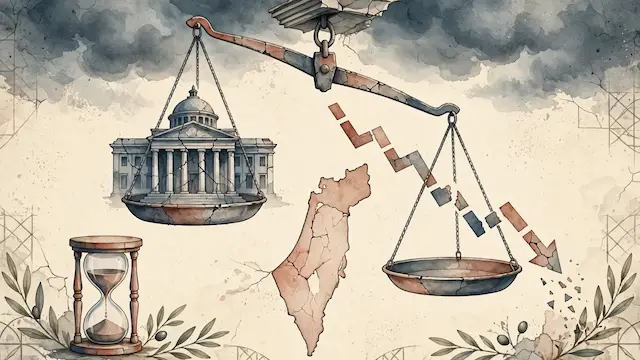
International credit rating agency Fitch has warned that the recent Knesset election results place Israel at increased risk of prolonged political uncertainty and a lengthy period of a caretaker government. Fitch stated that the political deadlock and the real possibility of lacking a stable parliamentary majority for government operations are consistent with Israel's current credit rating of 'A' with a negative outlook.
Following the elections, the Likud party is projected to remain the largest faction with approximately 27 seats. However, the bloc led by Prime Minister Benjamin Netanyahu secured only 53 seats, falling short of the 61 needed to form a coalition. Conversely, the bloc led by Gadi Eisenkot garnered 48 seats, alongside Arab parties holding 19 seats. These results come after an impressive voter turnout of 78%, up from 71% in the 2022 elections.
Fitch highlighted the complex constitutional process ahead. Under Israeli law, the President is most likely to grant Netanyahu the first mandate to form a government for 28 days, with a possible 14-day extension. If Netanyahu fails, the mandate would pass to Eisenkot for 28 days. Should this also fail, the President could task another Knesset member if at least 61 members explicitly request it.
The agency assesses that the chances of forming a stable 61-seat coalition are not high. While a theoretical scenario of a broad coalition uniting Netanyahu's and Eisenkot's blocs without the ultra-Orthodox parties exists, it is not considered the base case. If coalition talks fail, the Knesset would dissolve, leading to elections within 90 days, with the outgoing government continuing as a caretaker administration.
Fitch analysts anticipate that the most likely scenario involves the Knesset dissolving in early January, with new elections in early April. This timeline aligns with budget mechanisms, as failure to approve the state budget by March 31st automatically dissolves the Knesset. While March 31st is not an absolute final deadline, a lack of agreement by the legal date would trigger dissolution.
This outcome suggests Israel may return to a pattern of unstable coalitions and frequent caretaker governments, similar to the period between 2019 and 2022 which saw five elections. With the current outgoing coalition lacking a parliamentary majority, approving the 2027 state budget before new elections appears highly improbable. The absence of an approved budget would necessitate forced austerity measures under fiscal rules, limiting monthly government spending to one-twelfth of the lower of the previous year's ceiling or the adjusted allowed expenditure based on population growth.
Fitch emphasized that this temporary reduction in the deficit should not be mistaken for fiscal consolidation, as it stems solely from political paralysis rather than responsible policy or long-term reforms. The agency expects Israel's debt-to-GDP ratio to continue a moderate rise, a key factor maintaining the negative outlook on the country's credit rating.




