
Serbia Attack Near Israeli Embassy: "Unclear if We Were the Target"
Translated & summarized from Arutz Sheva by baba
An ISIS-affiliated attacker targeted a police officer near the Israeli Embassy in Belgrade, Serbia, with motives still under investigation. Rabbi Yitzchak Asiel of the Mizrachi movement stated it's unclear if the embassy was the main target. Despite the incident, the Jewish community feels relatively secure due to strong security and cooperation with authorities. However, anti-Israel protests have increased since October 7th, and the community is observing the new government's stance towards Israel.
The story in 6 lines · by baba
- An ISIS-affiliated attacker targeted a police officer near the Israeli Embassy in Belgrade, Serbia.
- It is unclear if the Israeli Embassy was the primary target of the attack, pending investigation.
- The Jewish community in Serbia feels relatively secure compared to other European nations.
- Anti-Israel protests have increased in Serbia since the October 7th attacks.
- The community is observing the new Serbian government's stance towards Israel.
- The local Jewish community numbers approximately 2,000 families.
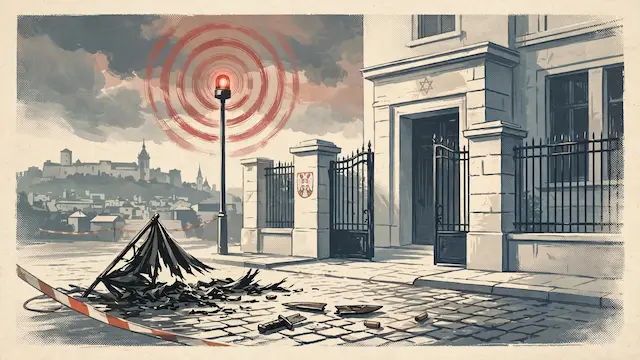
A stabbing attempt near the Israeli Embassy in Belgrade, Serbia, has raised questions about the attacker's motives, according to Rabbi Yitzchak Asiel, representative of the Mizrachi movement in Serbia. The assailant, identified as being affiliated with ISIS, attacked a police officer and was subsequently neutralized. Rabbi Asiel stated that it remains unclear whether the Israeli Embassy, a Jewish institution, or the police officer was the primary target, pending the outcome of an investigation. He noted similarities to an incident two years prior involving a Serbian convert to Islam who had approached a synagogue before being killed by police near the Israeli embassy.
Despite the incident, Rabbi Asiel emphasized that the Jewish community in Serbia feels relatively secure compared to other European countries, citing strong security measures and cooperation with local authorities. He mentioned that relations with the police and government were particularly good under the previous administration, which he described as distinctly pro-Israel. Many Israelis reside or visit Serbia for work, and numerous sports clubs have relocated their games there since October 7th, finding it safer than France, the UK, Germany, or Belgium.
The local Jewish community numbers approximately 2,000 families, with many members over 60. Younger generations tend to emigrate, often to Israel, the US, or Canada. Rabbi Asiel described the community as active and respected within Serbian society, recalling positive interfaith interactions. However, he acknowledged that since the October 7th attacks and the subsequent war in Gaza, anti-Israel protests have emerged in Serbia, initially met with police intervention to limit displays like Palestinian flags. These protests have since become more widespread, particularly involving demonstrators from the Muslim region in southern Serbia, incorporating anti-Israel narratives.
Rabbi Asiel also noted the political shift in Serbia following the opposition's electoral victory, expressing uncertainty about the new government's stance towards Israel, though initial assessments suggest no significant change. He reiterated that cooperation with authorities continues and the community does not perceive the same level of threat as seen in other European nations.
Mentioned
The same event, reported separately by each outlet. Open a few to compare what different newsrooms emphasize — and what they leave out.
Right 1Haredi 1

Not the same event — other stories that share this one’s people, places, or theme: background, reactions, and follow-ups.


