
Israeli Shekel Drops Sharply Against Dollar and Euro Amid Political Uncertainty
Translated & summarized from Ice by baba
The Israeli shekel weakened significantly against the dollar and euro on Wednesday due to political uncertainty following election results. The shekel dropped about 1.3% against the dollar and 1.2% against the euro. Business owners are advised to consider fixing exchange rates, while mortgage holders are reassured that the dollar's rise does not directly affect shekel mortgage rates.
The story in 5 lines · by baba
- The Israeli shekel weakened by 1.3% against the dollar and 1.2% against the euro on Wednesday.
- Political uncertainty following election results is cited as the primary cause for the shekel's decline.
- Accountant Eran Buchris advised businesses to consider fixing exchange rates due to currency volatility.
- Mortgage CEO Meir Weider stated the dollar's rise does not directly impact shekel mortgage interest rates.
- The currency volatility is expected to continue until the coalition picture in Jerusalem becomes clear.
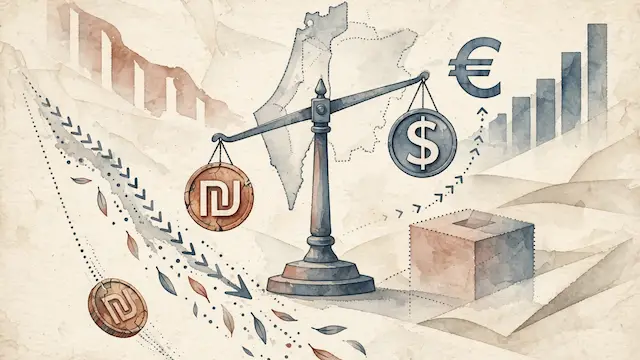
The Israeli shekel experienced a significant decline on Wednesday, weakening by approximately 1.3% against the US dollar and trading at 3.09 shekels per dollar. Simultaneously, the local currency fell by 1.2% against the Euro, reaching 3.43 shekels. This sharp depreciation follows a recent trend of shekel strengthening, which market analysts attributed to expectations of a decisive victory for Gadi Eisenkot and the "Change bloc." However, as election results became clearer, it emerged that despite Benjamin Netanyahu taking a substantial lead, the current political landscape does not guarantee him a stable government of 61 Knesset members. This political stalemate and the fear of continued instability prompted investors to move towards the dollar, re-exerting pressure on the shekel.
The currency's volatility has raised concerns for businesses and households. Eran Buchris, an accountant and strategic business consultant, highlighted the challenges for small and medium-sized businesses, noting that a rise of just 5 agorot in the dollar's exchange rate can increase the cost of a $50,000 payment to a foreign supplier by 2,500 shekels before fees. For businesses with low profit margins, this could significantly erode profits. Buchris advises against speculating on a dollar decrease, recommending instead that businesses explore fixing exchange rates and re-pricing unfinished deals.
Meanwhile, mortgage holders are also facing uncertainty. Meir Weider, CEO of Weider Mortgages, advised those planning to sign mortgage agreements not to be alarmed by the dollar's strengthening and postpone their plans. He explained that the dollar's exchange rate does not directly impact shekel-denominated mortgage interest rates, and any potential effect on the broader economy's interest rates would be indirect and not immediate. Weider's recommendation is to avoid betting on currency fluctuations and instead focus on verifying interest rate approvals and negotiating with banks before signing.
Mentioned
The same event, reported separately by each outlet. Open a few to compare what different newsrooms emphasize — and what they leave out.
Centre 2Right 1Other 1




Not the same event — other stories that share this one’s people, places, or theme: background, reactions, and follow-ups.

