
Israel Election Outcome Uncertain, Government Formation Could Take Weeks
Translated & summarized from i24NEWS French by baba
Following Israeli elections, the formation of a new government is uncertain and could take weeks, with multiple scenarios including a Netanyahu or Eisenkot-led government, a minority administration, or new elections. Official results are due November 4, after which President Herzog will begin consultations to assign the mandate to form a government, a process that could extend up to 70 days before new elections are automatically triggered if no agreement is reached.
The story in 6 lines · by baba
- Israel's government formation process could take weeks after elections, with multiple potential outcomes.
- Prime Minister Benyamin Netanyahu and Gadi Eisenkot lead opposing blocs vying for a majority.
- Scenarios include Netanyahu's coalition, an Eisenkot-led government, a minority cabinet, or a unity government.
- A minority government would face significant legislative and budgetary challenges.
- President Itshak Herzog will consult parties to assign the mandate to form a government.
- Failure to form a government within the allotted time will lead to automatic new elections.
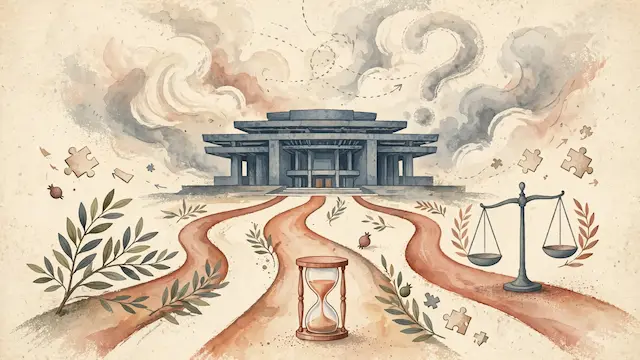
Following the closing of polling stations in Israel, the path to forming a new government remains uncertain, with the process potentially taking weeks even if a clear majority emerges. Several scenarios are possible, including the continuation of Prime Minister Benyamin Netanyahu's coalition, the formation of a government led by Gadi Eisenkot, a minority government, a unity government, or a repeat election.
If Netanyahu's right-wing bloc secures a decisive victory, he will likely attempt to reassemble his current coalition, comprising the Likud party, Orthodox factions, and right-wing parties like Otzma Yehudit and Religious Zionism. Conversely, if Eisenkot's bloc wins, he would aim to form a government with his Yashar party, Naftali Bennett's Yamina, Avigdor Lieberman's Yisrael Beiteinu, and Yair Golan's Democrats.
A minority government is also a possibility, where a bloc could win investiture with just over half the votes in the Knesset, provided some parties, potentially Arab parties, abstain. However, such a government would face significant challenges in passing legislation and budgets, a prospect that Avigdor Lieberman opposes due to fears of imminent political crisis.
In the event that neither bloc achieves a majority, a cross-party unity government could be considered, theoretically involving an alternating premiership between Netanyahu and Eisenkot, though both have thus far rejected this idea. President Itshak Herzog may attempt to broker a compromise, but he lacks the authority to impose one.
Should no agreement be reached, Israelis would face new elections, with Netanyahu and his ministers continuing to manage current affairs in the interim. The Central Elections Committee must complete the vote count, including special ballots, with official results expected by November 4. President Herzog will then consult with party delegations to designate a candidate to form a government, who will have up to 42 days to succeed. If this fails, a final 21-day period allows 61 Knesset members to propose a candidate, with a further 14 days to form a government. Failure in this final stage would automatically trigger new elections.
Mentioned




