
Israeli Election Officials Detail Rules for Valid Ballots
Translated & summarized from Now 14 by baba
Israel's Central Elections Committee has outlined rules to prevent ballot disqualification in the 26th Knesset elections, after nearly 30,000 votes were voided in the previous election. Voters must use official ballots without alterations, and specific rules apply to blank ballots and envelopes containing multiple or unapproved party lists. Ballots from the withdrawn "Achi" movement will be disqualified.
The story in 5 lines · by baba
- Nearly 30,000 votes were disqualified in Israel's previous election, representing about 0.6% of the total.
- Ballots with added markings, signatures, or drawings are subject to disqualification.
- Using a blank ballot requires writing the party's letters and nickname in blue ink.
- Envelopes containing ballots from two different parties or more than three ballots will be invalidated.
- Ballots from the "Achi" movement, which withdrew from the election, will be disqualified.
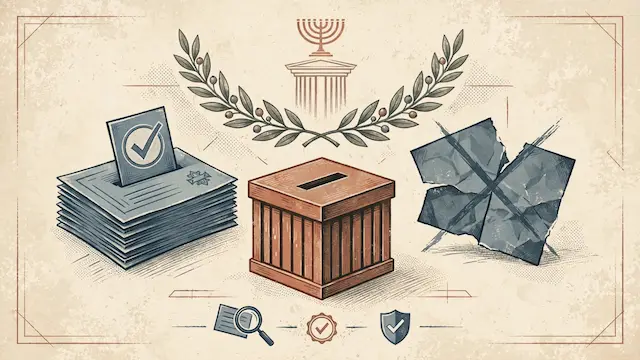
Ahead of the 26th Knesset elections, the Central Elections Committee has clarified the rules for ballot validity to prevent votes from being disqualified. In the previous election in November 2022, 29,851 votes, approximately 0.6% of the total, were invalidated. These disqualified votes do not count towards the distribution of mandates or the electoral threshold, effectively rendering them lost.
To ensure a vote is counted, voters must use the official printed ballots as provided, without adding any extra words, signatures, drawings, or other markings, which can lead to disqualification. If a voter's preferred party's ballot is unavailable, they can request a blank ballot from the polling committee and write the party's letters, or its letters and nickname, using a blue pen. The writing must be in Hebrew, Arabic, or both. A blank ballot with no writing, or one with only a nickname but no letters, will be disqualified.
Envelope usage also carries specific rules. An envelope containing ballots from two different parties will be invalidated. Similarly, an envelope with more than three ballots, even if they are identical, will be disqualified. However, two or three identical ballots are permissible, with only one being counted. The envelope must be the one supplied by the committee and must bear the signatures of two polling committee members.
A special case for the current election involves the "Achi" movement, which withdrew from the race. Their ballots, identified by the letters "צבי," were not to be placed in voting booths. Any ballot found for this list, whether printed or handwritten, will be disqualified, including votes already cast abroad and by military personnel.


