
Israel's Road Safety Crisis Ignored Amidst Aviation Scare
Translated & summarized from Davar by baba
A near-fatal incident on a Flydubai flight has sparked public outcry, but an Israeli news analysis argues this attention distracts from the far deadlier, ongoing crisis on Israel's roads. Since the start of 2026, 363 people have died in traffic accidents, with numbers rising annually. Despite numerous warnings from authorities and budget cuts to road safety initiatives, the government has failed to implement effective policies, leading to a preventable epidemic of road deaths.
The story in 6 lines · by baba
- 363 people have died in Israeli road accidents since the start of 2026.
- Road fatalities in Israel have risen significantly since 2022.
- The National Road Safety Authority's budget has been drastically cut.
- Numerous warnings about road safety have been ignored by officials.
- The government's allocated funds for road safety are insufficient.
- The article criticizes the lack of accountability for road deaths.
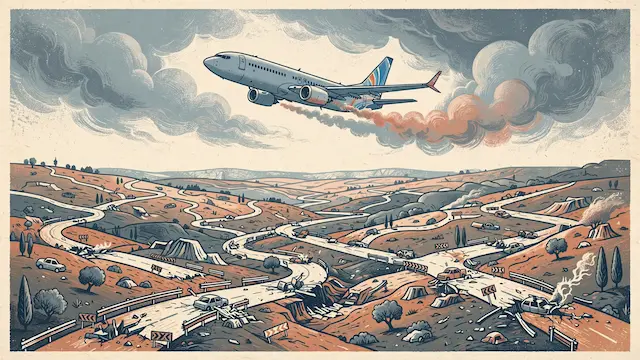
A near-disaster on a Flydubai flight, which endangered over 170 lives due to a series of failures and irresponsibility, has highlighted significant security and aviation system flaws. However, the article argues this incident should not overshadow the ongoing, and arguably more severe, crisis on Israel's roads.
As of the article's writing in early 2026, 363 people have died in road accidents since the start of the year, a number more than double those endangered on the flight. An additional 1,313 have been seriously injured. This ongoing tragedy has worsened under the current government, with road fatalities rising from 351 in 2022 to 439 in 2024 and 459 in 2025, averaging over 38 deaths per month.
Unlike the Flydubai incident, where failures were only revealed after the fact, numerous warnings about road safety have been issued for years by road safety organizations, the National Road Safety Authority, the Knesset Economics Committee, and the State Comptroller. Despite these warnings, policy changes have been insufficient. Boaz Toporovsky, chairman of a Knesset subcommittee on road safety, resigned in protest of the neglect. Ministers have also failed to attend crucial committee meetings on the issue.
The National Road Safety Authority's budget has been significantly cut, decreasing from approximately 91 million shekels in early 2023 to about 60 million shekels by late 2026. The authority has also suffered from leadership instability, operating without a permanent director general for most of 2023 and lacking both a director general and chairman for half a year. A former spokesperson, Sharon Baider, claimed she was fired for trying to draw public attention to the rising death toll.
In late 2025, the government allocated 300 million shekels annually to combat road accidents, but this was only a third of the amount recommended by the Road Safety Authority. Even this allocation was deemed insufficient by Economics Committee Chairman David Bitan. Despite these measures, there has been no significant decrease in fatalities. Responsibility for the crisis appears to be diffused, with the Ministry of Transportation, police, and other bodies deflecting blame.
The article concludes that while the Flydubai incident warrants public attention and investigation, the persistent and deadly crisis on Israeli roads, resulting in hundreds of preventable deaths and thousands of injuries, demands equal or greater urgency and accountability.