
Serbia Votes in Tense Election Amidst Protests and Fraud Claims
Translated & summarized from Ynet by baba
Serbia held parliamentary elections on Sunday, with long queues and record turnout seen as a challenge to the 12-year rule of Aleksandar Vučić. The vote was largely a referendum on Vučić and his ruling SNS party, facing a new opposition movement called the "Students' List" that emerged from anti-corruption protests. Concerns about voting irregularities have been raised by observers, and a close result could lead to political instability.
The story in 5 lines · by baba
- Serbia held parliamentary elections on Sunday, with record turnout challenging leader Aleksandar Vučić's 12-year rule.
- The election was a referendum on Vučić and his SNS party versus the new "Students' List" opposition.
- Protests against corruption, fueled by a deadly building collapse, propelled the "Students' List" to prominence.
- Concerns about voting irregularities, including alleged vote-buying, were reported by observers.
- A close election outcome could lead to prolonged political instability and potential unrest in Serbia.
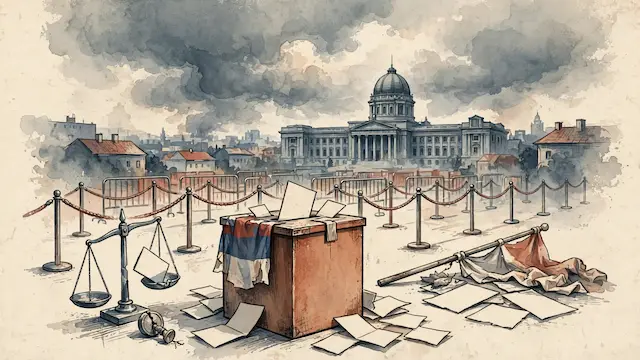
Serbia held parliamentary elections on Sunday, widely seen as a referendum on the 12-year rule of populist right-wing leader Aleksandar Vučić. Polls indicated a tight race between Vučić's ruling Serbian Progressive Party (SNS) and the newly formed "Students' List" party, which emerged from student protests against corruption. The protests gained momentum following a November 2024 tragedy in Novi Sad, where 16 people died in a building collapse, which many attributed to government corruption in infrastructure projects.
Vučić, who has led Serbia for 12 years, first as prime minister and then as president since 2017, resigned his presidency to run for prime minister again, as he is constitutionally barred from a third presidential term. While the prime minister's role is officially more expansive, Vučić maintained significant influence as president, often chairing government meetings and announcing key decisions.
The "Students' List," comprised of doctors, professors, actors, and farmers, promises to combat corruption, free the judiciary and public media from political influence, and dismiss officials blamed for violently suppressing recent protests. The party's leader, cardiologist Ilija Srdašnović, is not necessarily seen as the sole party leader, and his potential candidacy for prime minister remains unclear.
Election day saw unusually long queues at polling stations across Serbia and abroad, with a record voter turnout of 64.9% by 6 PM, the highest since Yugoslavia's dissolution in 1992. Vučić himself reportedly waited two hours to cast his ballot. Despite Vučić's claims of foreign funding for the opposition and accusations of wanting to destroy Serbia, his supporters credit him with economic growth and modernization. He has cultivated close ties with China and Russia while pursuing EU membership, though relations with Brussels have been strained.
International observers and local critics have raised concerns about irregularities during the voting process, including reports of voters photographing their ballots, suggesting potential vote-buying or coercion. "We are witnessing a significant number of irregularities and incidents outside the polling stations," stated Raša Nedeljkov, head of election monitoring at the independent organization CRTA. Analysts warn that a close result could lead to prolonged political instability and potential unrest, though Vučić has pledged to accept the outcome while also vowing to swiftly suppress any riots claiming fraud.
Mentioned
The same event, reported separately by each outlet. Open a few to compare what different newsrooms emphasize — and what they leave out.
Left 1Centre 2


Not the same event — other stories that share this one’s people, places, or theme: background, reactions, and follow-ups.

