
Tel Aviv Residents Fear Crime Surge Amid Rise in Homelessness and Drug Use
Translated & summarized from Cursorinfo by baba
Tel Aviv residents are increasingly concerned about a rise in drug addicts and homeless individuals, leading to fears of crime and a decline in public safety. Residents report finding used syringes, witnessing attempted break-ins, and feeling unsafe walking at night, with issues now spreading beyond previously affected areas. While the municipality states it is increasing street presence and providing aid, it attributes crime and drug trafficking to police responsibility. A new unit has been formed to address homelessness.
The story in 6 lines · by baba
- Tel Aviv residents report a surge in drug addicts and homeless individuals, causing fear and insecurity.
- Incidents include finding syringes, attempted break-ins, and open drug use in public spaces.
- Safety concerns have spread from southern Tel Aviv to central areas like Dizengoff Square.
- Residents criticize slow municipal responses to complaints about public disorder.
- The Tel Aviv municipality is increasing street presence and aid, while deferring crime issues to police.
- A new unit has been created to work with the homeless population.
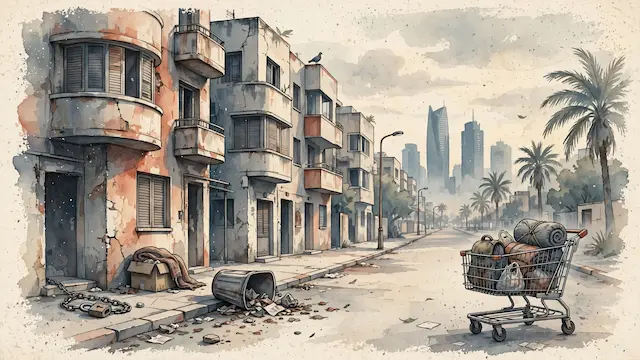
Residents of Tel Aviv are expressing growing fear due to a sharp increase in drug addicts and homeless individuals, who are reportedly terrorizing neighborhoods. Noa, a 31-year-old mother of a 1.5-month-old daughter living in the Montefiore neighborhood, stated she is afraid to walk with her child in the evenings. Despite security in her upscale building, she finds used syringes in the courtyard in the mornings and claims the area is overrun by homeless people at night. She recounted an incident where a homeless woman entered her building about a month prior, knocking on doors and shouting, and another where a man attempted to break into apartments with a saw. "We have security guards in our building, and I should feel especially protected. But that feeling is gone now," Noa said, adding, "I won't go down with the stroller in the evening and walk with the child. You feel like you're in Harlem here."
Previously, sanitation and security issues were mainly confined to the area around the old Central Bus Station and southern Tel Aviv. However, complaints have now spread to other parts of the city, including Dizengoff Square, Montefiore, Neve Tzedek, and streets near Rothschild Boulevard. Noa, a ten-year resident, noted a significant deterioration in the situation over the past year, stating that homeless people and drug addicts have flooded even the city center. She criticized municipal services for slow responses and infrequent patrols.
Adi, another resident, reported that homeless individuals regularly urinate near buildings and are seen with syringes. She also complained about dirt, shouting, harassment of cafe patrons, and attempted car break-ins, making her afraid to go out alone at night. Adi emphasized that the problem requires more than just expelling the homeless, acknowledging their difficult circumstances.
Yuval Ben-Gal, a 30-year-old fitness studio owner on Sirkin Street, reported seeing homeless people and drug addicts near her home in the city center over the past week, and stated that drug use is openly occurring at Dizengoff Square. The Tel Aviv municipality responded that combating crime and drug trafficking is the police's responsibility, but confirmed that city services are increasing their street presence and providing assistance to residents and the homeless. A special unit has been established in recent months, in conjunction with social services, to work with individuals experiencing homelessness. The municipality had previously suspended a project to relocate Nordau's separate beach to another location in the city's north.
Mentioned


