
Wildlife Populations Decline, But Nature's Recovery Offers Hope
Translated & summarized from Shakuf by baba
Global wildlife populations have declined by an average of 73% since 1970 due to human activities, according to a WWF report. However, numerous success stories, including the return of river otters to New York and European bison to the wild, demonstrate nature's capacity for recovery. Conservation efforts in places like the Galapagos and Israel, involving habitat restoration and protection, are proving effective in bringing back endangered species. These examples highlight the significant impact of human choices on wildlife survival and the potential for positive change.
The story in 5 lines · by baba
- Global wildlife populations have decreased by an average of 73% since 1970, according to a WWF report.
- Nature can recover when human impact ceases and ecosystems are allowed to regenerate, as shown by several success stories.
- River otters have returned to New York's Bronx River after a century-long absence due to pollution.
- European bison have recovered from near extinction to a wild population of approximately 6,800 by 2020.
- Conservation efforts in Israel have led to the return of the Barbel carp to the Yarkon River and the Persian fallow deer to the wild.
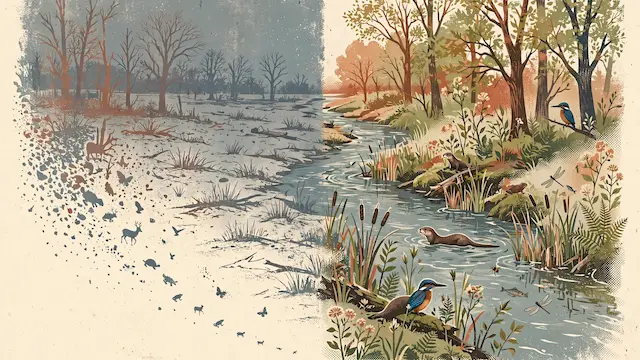
A report by the World Wildlife Fund (WWF) reveals a stark decline in global wildlife populations, which have shrunk by an average of 73% since 1970. This alarming figure reflects the cumulative impact of habitat destruction, pollution, hunting, overfishing, and climate change on thousands of species. However, the report also highlights numerous success stories demonstrating that nature can recover when human impact ceases and ecosystems are allowed to regenerate.
These success stories offer proof that the crisis is not irreversible. For instance, a North American river otter was documented in New York's Bronx River in the summer of 2026, marking its first appearance in the area in about a century. Decades of pollution had driven otters away, but restoration efforts have improved water quality, allowing the species to return even to a densely urbanized environment.
In the Galapagos Islands, green sea turtle populations are thriving due to protected nesting beaches, preserved feeding grounds, and restrictions on harmful activities. Despite ongoing threats like plastic pollution and climate change, sustained conservation efforts are crucial for their survival and reproduction.
The European bison also presents a remarkable recovery. Driven to near extinction by relentless hunting, with only a few individuals surviving in captivity by 1927, breeding programs and reintroduction efforts have allowed bison to return to European forests. By 2020, their wild population had grown to approximately 6,800 individuals, demonstrating that even species lost to the wild can be brought back with dedicated protection and long-term investment.
Other species like tigers and certain bluefin tuna populations are also showing signs of recovery. Tigers benefit from expanded protected areas and anti-poaching initiatives, while tuna populations are rebounding due to fishing restrictions and better marine resource management. These examples underscore that human actions, including habitat protection, law enforcement, and ecosystem restoration, are key to wildlife recovery.
Israel also has its own examples of nature's resilience. The Barbel carp, once nearly extinct in the Yarkon River due to severe pollution, has re-established itself following river restoration efforts. The Persian fallow deer, reintroduced to Israel through breeding programs after being hunted to extinction in the wild, now thrives in various parts of the country. These cases illustrate that when habitats are restored, animals are protected, and conservation efforts are sustained, species can return even from the brink.