
Dollar Trades Flat Against Shekel Amid Global Market Volatility
Translated & summarized from Calcalist by baba
The Israeli shekel traded flat against the U.S. dollar and euro on Friday, with the dollar showing slight global strength. This followed sharp declines on Wall Street and a flight to U.S. Treasury bonds amid rising oil prices and geopolitical concerns. The Bank of Israel recently held its interest rate steady at 3.25%, balancing inflation with risks from energy costs and exchange rates. Analysts suggest the dollar may be supported by its safe-haven status and local risk factors.
The story in 6 lines · by baba
- The Israeli shekel traded at 3.110 against the U.S. dollar and 3.488 against the euro on Friday.
- Wall Street experienced sharp declines, with the Nasdaq down 2.6% and S&P 500 down 1.2%.
- U.S. Treasury yields dropped significantly as investors sought safe-haven assets.
- Oil prices rose to a five-month high due to escalating Middle East tensions.
- The Bank of Israel maintained its interest rate at 3.25% on Wednesday.
- Analysts cite safe-haven demand and local risk as potential support for the dollar against the shekel.
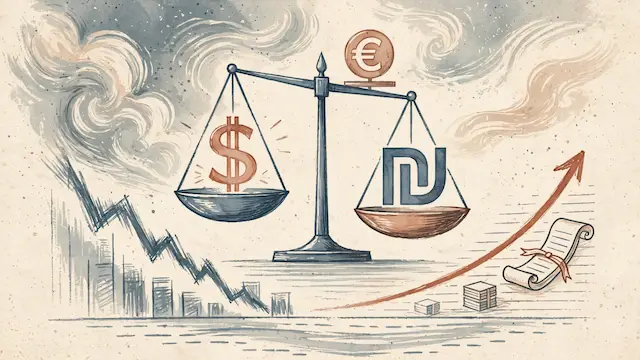
The Israeli shekel saw minimal movement on Friday, trading at 3.110 against the U.S. dollar and 3.488 against the euro. The British pound gained 0.1% to trade at 4.165 shekels. Globally, the dollar showed slight strength, rising 0.1% against the Japanese yen to 156.95 yen and its index against a basket of major currencies also climbed 0.1% to 101.505 points. These currency movements occurred in the wake of significant drops on Wall Street the previous day, driven by renewed concerns over artificial intelligence industry investments and corporate financing needs. The Nasdaq Composite plunged 2.6%, its worst day since June, while the S&P 500 lost 1.2%.
Amidst the stock market decline and rising oil prices, investors sought refuge in U.S. government bonds, considered a safe-haven asset during uncertain times. The yield on 10-year Treasury notes fell over 20 basis points to 4.945%, dropping below 5% for the first time since September 23, marking the sharpest daily yield decrease since March 10, 2023. Two-year note yields dropped 20 basis points to 4.629%, and 30-year yields fell nearly 15 basis points to 5.293%. This surge in bond prices reflects increased investor demand.
Meanwhile, oil prices continued to climb, following a 4% jump the previous day to a five-month high, attributed to escalating tensions between Saudi Arabia and the Houthis and fears of energy supply disruptions. The rising energy costs are fueling concerns about sustained inflationary pressures, potentially influencing central bank interest rate decisions. In Israel, the shekel's trading follows the Bank of Israel's decision on Wednesday to maintain its interest rate at 3.25%. While annual inflation stood at 1.6% in September, high energy prices, recent shekel weakening, and both local and global uncertainty remain key focus areas.
Yossi Menashe, Founder and Co-CEO of Altshuler Shaham Financial Services, commented that the Bank of Israel's decision reflects a balance between moderate inflation and the risks posed by rising energy costs and exchange rate developments. He noted that further oil price increases could heighten inflation expectations, pressure bond markets, and delay monetary easing in the U.S. and Europe. Menashe added that demand for the dollar as a safe-haven currency and increased local risk might support its value against the shekel, but the overall trend will also depend on global dollar movements and developments within Israel.
Mentioned

