
Global Tensions Rise Amid Iran Threats, Ukraine Attacks, and Market Volatility
Translated & summarized from 0404 by baba
Global tensions are high as Iran threatens regional attacks on energy infrastructure if attacked by the US and Israel, while Russia continues missile strikes on Ukraine. Markets are volatile with surging oil prices and sharp tech stock declines, and severe weather systems threaten millions in Asia and North America. Diplomatic efforts are underway to de-escalate the Iran conflict and potentially resume Ukraine peace talks, but significant challenges remain.
The story in 7 lines · by baba
- Iran threatens Persian Gulf energy infrastructure if attacked by US and Israel, claiming seven tankers hit.
- Russia launched a major missile attack on Ukraine, causing casualties and infrastructure damage.
- Global markets saw sharp declines, with tech stocks falling and oil prices surging to a five-month high.
- Typhoon Champi threatens Taiwan and Japan, while weather systems cause flooding on the US East Coast.
- Ebola outbreak in DRC expands, with over 9,700 cases and limited treatment options.
- Canada and Turkey forge strategic partnership, initiating free trade talks.
- Serbia faces parliamentary elections amid high political and social tension.
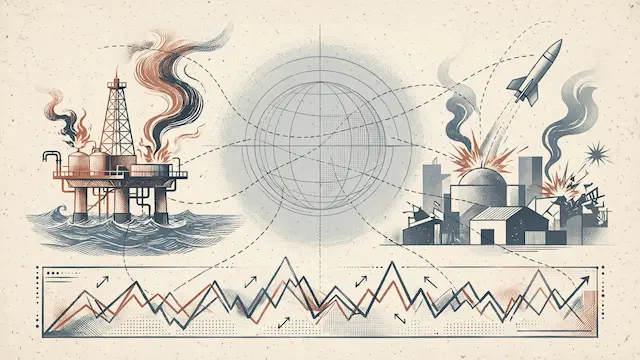
The world is on edge due to a series of escalating security, political, and economic developments. Iran has threatened to strike energy and technology infrastructure in the Persian Gulf if the United States and Israel renew attacks against it, with the Revolutionary Guards claiming seven oil tankers were hit in the Strait of Hormuz. Simultaneously, Russia launched a deadly missile attack on Ukraine, hours after expressing willingness to resume peace talks. Global markets experienced sharp declines, oil prices surged, and massive storms threatened millions in East Asia and North America.
The heightened tension between Iran, the US, and Israel intensified following stern warnings from Iranian officials about a potential renewed military campaign. Tehran indicated that further strikes on its nuclear facilities and strategic infrastructure could trigger a broad response beyond Iran's borders, potentially targeting oil facilities, undersea cables, data centers, and AI infrastructure in Gulf states, possibly involving up to seven countries. These threats emerged amid reports of operational plans being formulated by the US and Israel for a possible strike after the US midterm elections on November 3rd, though President Donald Trump has not yet authorized a new operation. Diplomatic efforts continue, focusing on Iran's nuclear program, sanctions relief, and freedom of navigation in the Strait of Hormuz.
The Iranian Navy announced that seven vessels were damaged in the Gulf and Strait of Hormuz, claiming four oil tankers were attacked and three others hit by mines. While independent verification of these claims is pending, the Iranian announcement and threats against US forces have increased fears of a wider naval conflict. The Revolutionary Guards warned that continued US military activity could lead to retaliation against US bases in Gulf states. Saudi Aramco announced it has significantly increased its oil transfer capacity via a pipeline bypassing the Strait of Hormuz to seven million barrels per day, reducing reliance on the threatened maritime route.
In Ukraine, Russia launched extensive missile attacks on Kyiv and other regions, resulting in at least four deaths and dozens of injuries, including children. Ukrainian authorities reported three waves of attacks involving 21 ballistic missiles, damaging residential buildings, transport hubs, and energy infrastructure. President Volodymyr Zelenskyy accused Moscow of deliberately targeting civilian infrastructure and warned of intensified attacks ahead of winter, noting 170 Russian attacks on vital energy facilities since October 11th. Russia, meanwhile, claimed its air defenses intercepted over 800 Ukrainian drones.
Despite the ongoing conflict, diplomatic efforts to end the war continue. Russian President Vladimir Putin agreed in principle to resume trilateral talks with Ukraine and the United States, following a meeting with US envoy Steve Witkoff. Talks are tentatively scheduled for after November 10th, with the UAE being considered as a potential host, though significant gaps remain between Moscow and Kyiv. The US administration hopes renewed negotiations will help establish a framework for a political settlement, while Ukraine insists progress is impossible as long as Russia continues its attacks.
International markets reacted to the geopolitical and economic uncertainties. Wall Street closed Thursday with sharp declines in tech stocks, particularly Meta and chip stocks, due to concerns over massive AI development spending. The Nasdaq fell 2.6%, its steepest daily drop since early June. Oil prices surged by about 4% to $113.17 per barrel for Brent crude, the highest in five months, fueling fears of renewed global inflation. In Europe, concerns grew over France's economic situation as its ten-year government bond yield surpassed the US equivalent for the first time since 2013.
Natural disasters are also impacting global stability. Typhoon Champi is threatening Taiwan and southern Japan with high winds and heavy rains, leading to flight cancellations and evacuations. In the US, weather system Josephine is causing strong winds, high waves, and coastal flooding along the East Coast. Tropical Storm Vance is developing off the coast of Mexico and could strengthen into a significant hurricane. Additionally, the Ebola outbreak in the Democratic Republic of Congo continues to expand, with over 9,700 cases and nearly half of those infected dying, complicated by ongoing fighting and limited medical resources.
In diplomatic news, Canada and Turkey announced a strategic partnership, signing agreements on defense industries, transportation, and energy, and initiating talks for a free trade agreement. Serbia is preparing for parliamentary elections amidst high political tension, with potential implications for its foreign policy and relations with the EU and Russia. The article concludes by reiterating the primary concern of escalating conflict between the US, Israel, and Iran, alongside the impact of Russian attacks in Ukraine, volatile energy prices, and AI investment concerns.
Mentioned

