
Israel Allows Unauthorized West Bank Outposts to Connect to Utilities Without Permits
Translated & summarized from Alarab by baba
Israel's military has amended planning laws to allow unauthorized settlement outposts in the West Bank to connect to water and electricity networks before their legalization plans are approved. The change, effective from September 23, 2026, is criticized by Bimkom, Planners for Human Rights as deepening discrimination against Palestinians. While settlers receive utility connections for unlicensed structures, Palestinian communities face demolition threats and lack basic infrastructure. The amendment is part of a broader government policy to legalize outposts, with 48 new settlements created through this process since February 2023.
The story in 6 lines · by baba
- Israel amended West Bank planning laws to connect unauthorized settlement outposts to utilities before legalization.
- The change, signed September 23, 2026, allows utility connections for structures built before February 12, 2023.
- Bimkom, Planners for Human Rights calls the move a further step in legitimizing outposts and increasing discrimination.
- The amendment is part of an Israeli government policy since February 2023 to legalize unauthorized outposts.
- 48 new settlements have been established by legalizing existing outposts since February 2023, according to Bimkom.
- Palestinian communities face demolition threats and lack basic infrastructure, unlike settlers receiving utility connections.
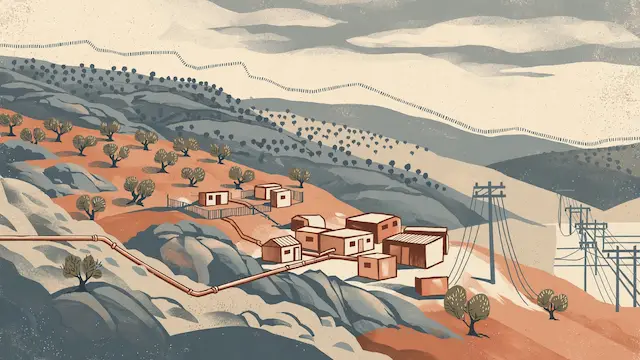
The Israeli military has approved an amendment to the Planning and Building Law in the occupied West Bank, enabling structures built without permits in settlement outposts to be connected to water and electricity networks even before their legalization plans are approved. The amendment was signed by the commander of the Israeli Ground Forces' Central Region on September 23, 2026. The organization Bimkom, Planners for Human Rights stated that this move further legitimizes settlement outposts in practice and deepens discrimination between settlers and Palestinians in the West Bank.
Previously, building permits were required to connect any structure to water and electricity. The new amendment exempts buildings erected before February 12, 2023, on public land or private land with owner consent, provided they are in locations the Israeli Civil Administration intends to legalize and planning authorities see a future possibility for approving their plans. This exception is granted for three years, extendable, allowing structures built without permits to receive utilities for years, even without approved building plans and without any guarantee of future approval.
This amendment is part of a policy adopted by the Israeli government since February 2023 to legalize unauthorized settlement outposts. According to Bimkom, the current government has announced the establishment of 104 new settlements in the West Bank, with 48 of them resulting from the legalization of existing outposts. Dozens of other outposts have been designated for legalization as neighborhoods of existing settlements.
Despite years of these procedures, few plans have been approved. Many outposts receive government support and have demolition and evacuation orders frozen before their legalization plans are finalized. The amendment highlights increased discrimination in Israeli planning and building policies in Area C, which constitutes about 60% of the West Bank and is under full Israeli control regarding planning and building.
While theoretically applicable to unauthorized Palestinian structures, the Israeli Civil Administration systematically rejects planning for Palestinian communities, some existing for decades. Palestinian communities often rely on solar panels for electricity and water tanks, which Israeli authorities sometimes confiscate, and live under constant threat of home demolition. Bimkom noted that connecting outposts to infrastructure began before the amendment, citing the "Ma'oz Tzur" outpost being connected to utilities on March 22, 2026, despite the land not being declared public and administrative boundaries not being defined.
Assaf Be'ild from Bimkom stated, "Israel continues to deepen discrimination between settlers and Palestinians in the West Bank. It facilitates access to water, electricity, and public services for settlers for buildings erected without permits, even before their building plans are approved. Conversely, it deprives Palestinians of building permits and basic infrastructure, leaving them under constant threat of home demolition. This amendment enshrines two different systems of planning and building in the West Bank: one that grants settlers facilities and paves the way for legalizing illegal construction, and another that denies Palestinians the possibility of legal construction and expansion."
Mentioned
The same event, reported separately by each outlet. Open a few to compare what different newsrooms emphasize — and what they leave out.
Arab 2

Not the same event — other stories that share this one’s people, places, or theme: background, reactions, and follow-ups.