
Smart Farming Tech Now Profitable on 42% of Global Farmland
Translated & summarized from Bizportal by baba
Smart farming technologies are now profitable on 42% of global cultivated land, according to a University of Bonn study. The research identified North America, Western Europe, and countries like Israel as leading regions, driven by high labor costs and supportive policies. Environmental policy was found to be the strongest predictor of profitability, with stricter regulations potentially increasing profitable land to 75% by 2045. The study also highlighted the need for technologies suited to smaller farms.
The story in 5 lines · by baba
- Smart farming technologies are now profitable on 42% of the world's cultivated land, covering 500 million hectares.
- North America, Western Europe, Australia, Japan, South Korea, and Israel are leading regions for profitable smart farming.
- Environmental policy is the most significant factor predicting the profitability of smart farming technologies.
- Stricter environmental policies could increase profitable smart farming land to 75% by 2045.
- The study highlights the need for technologies adapted to smaller farms, especially in regions like sub-Saharan Africa.
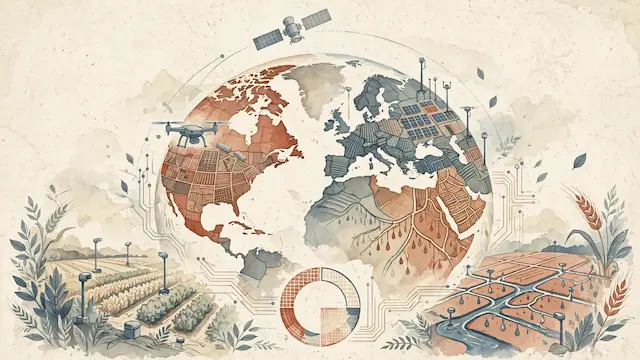
Smart farming technologies, including drones for mapping, precision fertilizer spreaders, robotic weeders, and GPS-guided tractors, are now economically viable for farmers on approximately 42% of the world's cultivated land, totaling about 500 million hectares. This finding comes from a study by the University of Bonn, published in the journal PNAS, which represents the first global assessment of smart agriculture's economic feasibility.
The research highlights North America and Western Europe as key areas, alongside wealthy nations like Australia, Japan, South Korea, and Israel. Researchers attribute this success in the US and Europe to a combination of high labor costs, income, education levels, infrastructure investment, and supportive policies for sustainable agriculture. Conversely, sub-Saharan Africa and parts of South Asia show low profitability, even under optimistic scenarios.
According to doctoral student Shahriar Roman, a lead author of the study, cost savings are significant when fertilizers and pesticides are applied precisely where needed, a benefit amplified by current disruptions in the Strait of Hormuz impacting fertilizer and fuel prices. The study's methodology involved a nine-month global survey of over 8,000 farmers and industry professionals, analyzing 4,422 locations where the technologies are already in use and profitable. Machine learning models then predicted profitability across all cultivated areas.
Environmental policy emerged as the most significant predictor of profitability. The researchers projected that under current economic trends, the area where smart farming is profitable will grow to 50% by 2045. However, if countries adopt stricter environmental policies, this figure could reach 75% by 2045. Conversely, a relaxation of environmental regulations could see profitability drop to 31% by 2045.
The study also noted that while smart farming technologies are developing rapidly, their adoption is influenced by factors beyond mere profitability, including the need for initial capital investment, risk tolerance, and technical expertise among farmers. Professor David Wefer emphasized the need for developing solutions tailored to smaller farms, particularly in regions like sub-Saharan Africa, where current technologies are often designed for large-scale operations.