
Pakistani Army Chief Visits Iran Amid IRGC Threats to Internet Cables
Translated & summarized from Arab48 by baba
Pakistani Army Chief Asim Munir visited Tehran on Tuesday amid escalating tensions. The Iranian Revolutionary Guard Corps threatened to target major internet cables passing under the Strait of Hormuz and warned of a "much more severe" response if war breaks out. The visit follows previous talks aimed at de-escalation and reopening the vital waterway. Negotiations between the US and Iran over Hormuz security previously collapsed.
The story in 5 lines · by baba
- Pakistani Army Chief Asim Munir visited Tehran on Tuesday for talks.
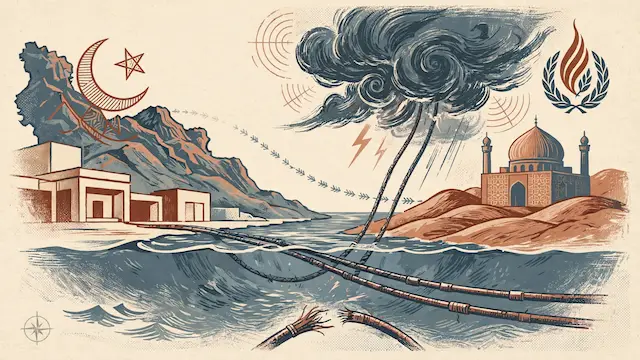
- The IRGC threatened to target 7 major internet cables passing under the Strait of Hormuz.
- An IRGC spokesperson warned of a "much more severe" Iranian response if war erupts.
- The visit follows previous discussions on de-escalation and reopening the Strait of Hormuz.
- US-Iran negotiations over Hormuz security collapsed in June.
Pakistani Army Chief Asim Munir arrived in Tehran on Tuesday, according to Pakistani officials and Iranian media. Pakistan has played a significant role in mediating between the United States and Iran this year. This visit follows earlier summer discussions between Munir and Iranian leaders focused on preventing further escalation, reopening the Strait of Hormuz, and ending conflicts swiftly.
The Iranian Revolutionary Guard Corps (IRGC) warned that "7 main internet cables pass under Hormuz, and the enemy must know that we have new targets." IRGC spokesperson Hossein Mohibi stated on Monday that Tehran does not rule out the possibility of war, cautioning that Iran's response this time would be "much more severe." Mohibi made these remarks on Iranian state television, discussing regional developments. He added that the US would face "very big problems" and the world would witness a "serious energy crisis." Mohibi also indicated that if the region becomes unsafe for Iran, no place will remain safe, and Tehran would employ "elements of surprise" if war escalates again.
In February, the United States and Israel allegedly launched a war against Iran, resulting in thousands of casualties. Tehran reportedly retaliated with attacks on Israel and what it described as American military facilities in Arab countries. Washington and Tehran signed a memorandum of understanding in June and began negotiations, which later collapsed due to disagreements over freedom of navigation and security in the Strait of Hormuz, a critical chokepoint for energy and goods.
Mentioned
The same event, reported separately by each outlet. Open a few to compare what different newsrooms emphasize — and what they leave out.
Centre 1Arab 1
