
US Warns Citizens of Heightened Risk in Middle East Amid Escalating Tensions
Translated & summarized from Cursorinfo by baba
The U.S. State Department has issued an urgent warning to American citizens in the Middle East to be extremely vigilant due to fears of conflict expansion. The warning comes amid escalating tensions between Saudi Arabia and Yemen's Houthis, and potential attacks by Iran and its allies. The article also discusses a broader global instability, citing numerous ongoing conflicts and the weakening of international security structures, with experts warning of potential miscalculations and a breakdown of the old world order.
The story in 5 lines · by baba
- U.S. State Department warns citizens in the Middle East to be highly vigilant due to conflict expansion fears.
- Escalating Saudi-Houthi tensions and potential Iranian-backed attacks are cited as reasons for the warning.
- The world faces unprecedented instability with approximately 65 armed conflicts, the highest since WWII.
- Experts warn of a breakdown in the international order and potential miscalculations by aggressors.
- German Chancellor Friedrich Merz described the current era as a dangerous interim state.
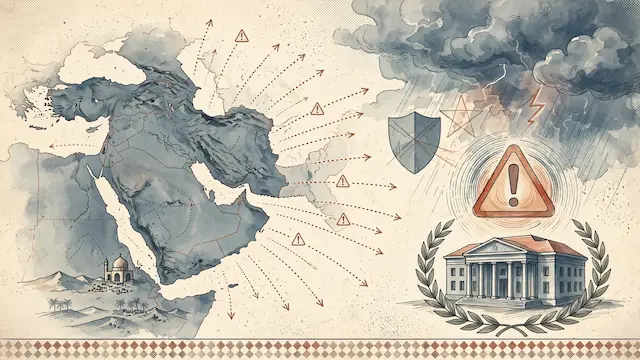
The U.S. State Department has issued an urgent warning to American citizens in the Middle East, urging them to exercise extreme vigilance. Diplomatic missions in the region, including the embassy in Jerusalem, published relevant notices. Washington fears a rapid expansion of the conflict zone due to escalating tensions between Saudi Arabia and Yemen's Houthi rebels, who continue to strike critical infrastructure and civilian airports in the kingdom. Additionally, U.S. authorities caution that Iran and its affiliated groups may target American interests and businesses globally. Citizens are advised to monitor diplomatic mission updates and travel advisories, as flight cancellations and airspace closures are possible.
The broader international security landscape is described as highly unstable, with multiplying conflicts, intensifying great power rivalry, and diminishing effectiveness of traditional deterrence mechanisms. Observer Gideon Rachman suggests that scenarios once considered science fiction are becoming more realistic, indicating profound shifts in the global system. The full-scale Russian invasion of Ukraine in February 2022 is cited as a clear sign of the breakdown of the European security order and the erroneous assumption that large-scale war in modern Europe was improbable.
According to the International Crisis Group, there are approximately 65 armed conflicts worldwide, the highest number since World War II, with major confrontations in Ukraine, Gaza, and Sudan. Middle East tensions are becoming regional, threatening even traditionally stable Gulf states. Rachman highlights the dangerous intertwining of conflicts, noting North Korea's military support for Russia and Ukraine's sharing of drone defense experience with Gulf nations. Growing cooperation between Moscow, Beijing, Tehran, and Pyongyang concerns Western intelligence agencies, who see it as a potential bloc against the existing international order.
Economic shifts are also noted, with the G7's share of global industrial production falling from about two-thirds in the late 1980s to roughly 43% by 2022, empowering states seeking to revise international rules. The return of military power politics, with authoritarian states using force and ambiguous signals from Western leaders undermining allies' confidence in security guarantees, is another risk factor. Rachman identifies a decline in confidence regarding U.S. commitment to defending its partners as a serious problem, potentially increasing the risk of miscalculation by aggressors. He draws parallels to the 20th century, where aggressors underestimated democratic resolve, warning of similar miscalculations amid the current international imbalance. German Chancellor Friedrich Merz described the current period as a dangerous interim state where the old world order has collapsed, but a new stable system has yet to emerge.
Mentioned



