
Israel Escalates Military Actions in Southern Lebanon Ahead of Talks
Translated & summarized from Arab48 by baba
Israel escalated military actions in southern Lebanon on Sunday with artillery, airstrikes, and demolitions ahead of planned US-mediated talks. Lebanese President Joseph Aoun stated the Lebanese delegation will present demands to halt the escalation at the October 20th meeting in Tampa, USA. Hezbollah refuses to disarm while Israeli forces remain in Lebanon, and Israel maintains military pressure. Israel has also increased its northern border readiness amid reports of Hezbollah's heightened military activities.
The story in 6 lines · by baba
- Israel conducted artillery shelling, airstrikes, and house demolitions in southern Lebanon on Sunday.
- Lebanese President Joseph Aoun will present demands to halt Israeli escalation at upcoming US-mediated talks.
- Hezbollah refuses to disarm as long as Israeli forces remain in Lebanese territory.
- Israel has raised its northern border alert level and deployed additional troops.
- Unnamed Lebanese sources report increased Hezbollah military activities and recruitment.
- Israeli Defense Minister Israel Katz warned Hezbollah of severe consequences for joining any attack on Israel.
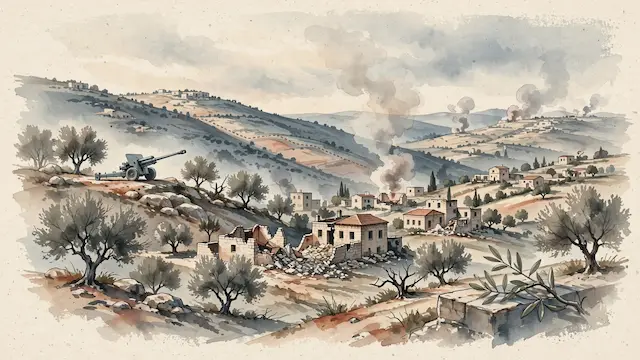
The Israeli military intensified its operations in southern Lebanon on Sunday, employing artillery shelling, airstrikes, and house demolitions. These actions coincided with troop movements within several southern Lebanese towns. The National News Agency of Lebanon reported that Israeli artillery targeted the towns of Mansouri, Sarbin, Beit Yahoun, and Zawtar al-Sharqiyya, while airstrikes hit Qantara and Bani Hayyan. Israeli forces also conducted demolitions in Khiyam, Kfar Tibnit, and Zawtar al-Sharqiyya, continuing search operations and vehicle movements in Khiyam.
This escalation occurs shortly before a planned trilateral meeting in Tampa, USA, on October 20th. A Lebanese military delegation is expected to attend this meeting to present Beirut's demands for an end to Israeli attacks. The discussions, mediated by the US, aim to address a cessation of hostilities, the disarmament of Hezbollah, and a gradual Israeli withdrawal from Lebanese territory, according to Reuters.
Lebanese President Joseph Aoun stated on Saturday during a meeting with French Foreign Minister Jean-Noël Barrot that the Lebanese delegation would convey their country's demands to halt the escalation. He expressed hope for outcomes aligned with the framework agreement. Aoun accused Israel of ongoing aggressions, destroying homes, and preventing farmers from accessing their land, asserting that the continued occupation and tension in the south hinder the Lebanese army's deployment to the international border as per Resolution 1701.
Regarding international forces, Aoun conveyed Lebanon's desire for an extension of their presence or continuation of their security missions beyond 2027, warning against a potential vacuum if they withdraw and stressing the need for an international presence in the south. Hezbollah, however, refuses to disarm as long as Israeli forces remain in Lebanese territory, while Israel insists on maintaining military pressure.
In a related development, the Israeli military radio reported that the army would permit olive harvesting within the southern security zone, stretching from Shebaa in the east to Alma al-Shaab in the west, under Israeli coordination and supervision, involving Lebanese and Syrian workers. Meanwhile, Lebanese Foreign Minister Youssef Al-Raji condemned Israel's continuous attacks on Lebanon's sovereignty and territorial integrity at an Organization of Islamic Cooperation meeting. He also called on Iran and its affiliated groups to cease aggressions against Gulf Cooperation Council countries and Jordan.
Concurrently, Israel heightened its alert level on its northern front, deploying troops from the 36th and 91st divisions to the Golan Heights and southern Lebanon, reinforcing the border with additional units, including Golani Brigade battalions and training units, according to the newspaper Maariv. The paper attributed these measures to preparations for potential escalation, citing unnamed Lebanese sources who reported increased Hezbollah military activities, including recruitment and the establishment of defensive systems in areas of the Beqaa Valley, the coast, and Beirut's southern suburbs, with the possibility of attacks against Israeli forces. Israeli Defense Minister Israel Katz warned Hezbollah against joining Iran in any attack on Israel, threatening a severe response and the seizure of additional areas in southern Lebanon, particularly between Nabatieh and the Litani River, to establish a permanent security zone.
Mentioned
