
Spain's Defense Woes Mount After Canceling Elbit Deal
Translated & summarized from Globes by baba
Spain's defense capabilities are in question after canceling a deal with Israel's Elbit Systems for advanced PULS rocket artillery. The Spanish military now faces an "unclear" future for its rocket program due to the cancellation, which was part of a broader freeze on defense deals with Israel. Meanwhile, U.S. defense firm Anduril Industries is expanding into submarine manufacturing and the U.S. Army is seeking a deployable air defense system for tactical vehicles.
The story in 6 lines · by baba
- Spain's artillery program is in an "unclear" state after canceling a deal with Israel's Elbit Systems.
- The Spanish government froze all defense deals with Israel in September last year, impacting military modernization.
- Anduril Industries is establishing a submarine manufacturing plant in Baltimore, Maryland.
- The U.S. Army is seeking companies to develop a deployable air defense system for tactical vehicles.
- Anduril's revenue doubled to $2.2 billion in 2025, with a valuation of $61 billion.
- General Antonio Mongio Bergua commands the Spanish Artillery.
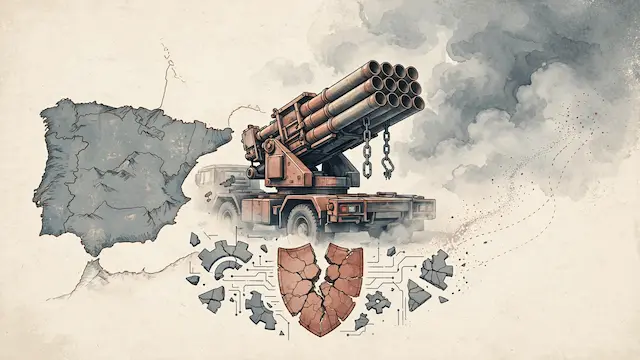
Spain's defense capabilities are facing significant challenges following the cancellation of a deal with Israeli defense firm Elbit Systems, leaving the country without advanced artillery. General Antonio Mongio Bergua, commander of the Spanish Artillery, admitted that the future rocket program is in an "unclear" state. Madrid had recognized the need to rebuild its military capacities in 2023, a decade after retiring the "Teruel" system, and had chosen Elbit's PULS system as a solution. The PULS system is a comprehensive rocket artillery system capable of firing unguided rockets, precision munitions, and missiles up to 300 km. The original agreement included technology transfer and local production of rockets, launchers, and ammunition, along with 12 launchers and 600 rockets, plus radars and drones. However, the Spanish government under Pedro Sanchez froze all defense deals with Israel in September last year, leading to the cancellation.
Spain then turned to domestic industry, with EM&E and Rheinmetall presenting a plan for full independence in December. Despite a subsequent cooperation agreement between EM&E and GMV in January, no significant progress has been made. Sources indicate that a major obstacle is the lack of willingness from other countries to share technology and knowledge with Spain, a stark contrast to the comprehensive transfer included in the Elbit deal. It is believed that Spain would have possessed the PULS system by now if not for the government's actions.
Meanwhile, defense technology company Anduril Industries is expanding aggressively, establishing a submarine manufacturing plant in Baltimore, Maryland. This facility, known as Arsenal 2, will contribute to the production of Virginia-class nuclear attack submarines, including torpedo tubes. This move marks a significant shift for Anduril, which previously focused on unmanned maritime and submersible systems. The company's expansion into submarine manufacturing is likely driven by the U.S. failure to meet its target of producing two submarines annually. Anduril, founded in 2017, has experienced rapid growth, recently completing a $5 billion funding round that values the company at $61 billion, and doubling its revenue to $2.2 billion in 2025.
In other defense news, the U.S. Army is seeking companies to develop a deployable air defense system for tactical vehicles. Scheduled for October 27-28, a briefing in Alabama will allow companies to present their plans for a surface-based air defense system that can be loaded onto any vehicle to protect tactical forces against drones, helicopters, and aircraft. The M-SHORAD 4 system aims to provide a defense against various unmanned aerial vehicles, from small drones to those weighing around 600 kg, as well as helicopters and fixed-wing aircraft.