
Herzog's Flight Over Turkey Sparks Ankara-Baku Diplomatic Crisis
Translated & summarized from Cursorinfo by baba
A diplomatic conflict between Turkey and Azerbaijan has intensified following Israeli President Itzhak Herzog's flight through Turkish airspace on an Azerbaijani plane. The incident, coupled with Azerbaijan's restrictions on hijab use in schools and a criminal case against a Turkish journalist, has exposed deep disagreements. Despite public criticism, both nations' leaders are seeking to manage the crisis and preserve their strategic partnership, with Turkish Foreign Minister Hakan Fidan meeting Azerbaijani President Ilham Aliyev on October 16.
The story in 6 lines · by baba
- Israeli President Itzhak Herzog's flight through Turkish airspace on an Azerbaijani plane has triggered a diplomatic crisis between Turkey and Azerbaijan.
- Azerbaijan allegedly failed to notify Turkey in advance about President Herzog's presence on the flight crossing Turkish airspace.
- Restrictions on hijab use in Azerbaijani schools and protests have led to public criticism from Turkish officials.
- Azerbaijan has accused Turkey of interfering in its internal affairs regarding the hijab issue.
- A criminal case opened against a Turkish journalist in Azerbaijan has further strained relations between the two allied nations.
- Despite tensions, Turkish Foreign Minister Hakan Fidan met Azerbaijani President Ilham Aliyev on October 16 to emphasize strategic partnership.
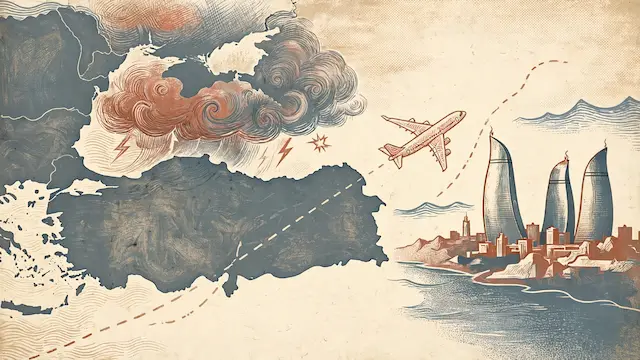
A diplomatic spat has erupted between Turkey and Azerbaijan, exacerbated by Israeli President Itzhak Herzog's recent flight through Turkish airspace en route to Baku. Herzog traveled on an Azerbaijan Airlines Boeing 787 named "Shusha" on a regular flight, which crossed Turkish territory despite Ankara's existing restrictions on Israeli government aircraft. This incident has highlighted significant rifts between the two traditionally close allies, often described as "one nation, two states."
According to Middle East Eye, an unnamed Turkish source claimed Azerbaijan did not pre-notify Ankara of the Israeli president's presence on the flight, though Turkish authorities do not receive passenger manifests for all aircraft. The flight's route sparked criticism in Turkish media and social networks, with some viewing Baku's actions as a deliberate disregard for Ankara's stance on Israel. Turkish commentator Adnan Hasanoglu strongly criticized Azerbaijani President Ilham Aliyev's decision, calling it an open political stance against Turkey incompatible with fraternal relations.
Beyond the presidential flight, other factors are straining Turkish-Azerbaijani ties. Protests have occurred in Azerbaijan since late September against school dress codes that effectively restrict hijab use, leading to detentions. Turkish ruling party officials, including advisor Oktay Serel, publicly opposed these restrictions, but Baku accused Turkish politicians of interfering in its internal affairs, with the ruling "Yeni Azerbaijan" party labeling the criticism as political manipulation.
Further complicating matters, on October 17, Azerbaijan's prosecutor's office opened a criminal case against Turkish journalist Jalal Chipchi for alleged calls for violent government overthrow via social media. A court issued an arrest warrant, and Baku requested Turkish assistance. This adds a law enforcement cooperation issue to the political disagreements.
Despite the public friction, leaders from both Turkey and Azerbaijan are working to prevent further deterioration. Turkish Foreign Minister Hakan Fidan met with President Aliyev in Baku on October 16, emphasizing the paramount importance of their strategic partnership. Kursad Zorlu, deputy chairman of Turkey's ruling party, also advocated for resolving differences internally, likening the situation to resolving issues "within the family."
Mentioned
The same event, reported separately by each outlet. Open a few to compare what different newsrooms emphasize — and what they leave out.
Other 2

Not the same event — other stories that share this one’s people, places, or theme: background, reactions, and follow-ups.



