
Iran Continues Missile Program Development Underground After Strikes
Translated & summarized from Cursorinfo by baba
Iran is rebuilding its ballistic missile infrastructure underground after U.S. and Israeli strikes, potentially using existing components to maintain a threat to Israel. Satellite imagery analysis reveals ongoing activity in subterranean complexes, while surface facility restoration is slow. Key sites like Parchin, Khojir, and Shahroud show significant damage, but new underground construction is underway, suggesting a strategy to protect critical operations from future attacks. The full extent of Iran's missile readiness remains uncertain.
The story in 6 lines · by baba
- Iran is expanding underground facilities to continue ballistic missile production after U.S. and Israeli strikes.
- Satellite imagery shows ongoing activity in subterranean complexes while surface facility restoration lags.
- Key Iranian missile sites like Parchin and Khojir sustained significant damage.
- New underground construction is underway at Shahroud, indicating a strategy for future protection.
- The missile threat to Israel and regional U.S. allies persists despite infrastructure damage.
- Restoring full production capacity could take up to a year, depending on resources and components.
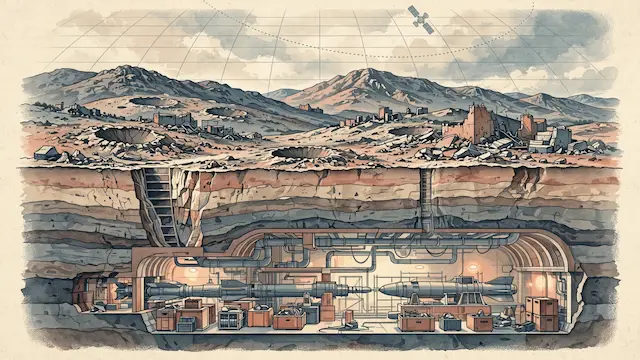
Iran is actively rebuilding its ballistic missile infrastructure, focusing on expanding underground facilities to continue production and assembly following significant strikes by the U.S. and Israel. Despite damage to major facilities, Tehran appears capable of assembling weapons from existing components, maintaining a missile threat to Israel and regional U.S. allies. The extent of Iran's recovered arsenal remains unclear.
A study by the Foreign Policy Research Institute (FPRI), analyzing recent satellite imagery of key sites like Parchin, Khojir, and Shahroud, indicates ongoing activity in subterranean complexes while surface facility restoration lags. This analysis followed the lifting of restrictions on commercial satellite access to Iranian imagery and corroborates reports of Iran resuming ballistic missile assembly in protected underground locations, potentially using stockpiled components.
The Parchin complex, previously a hub for solid-fuel rocket engines, remains heavily damaged with its main production line non-operational. Restoration efforts there are primarily focused on repairing damage sustained during a June 2025 conflict. However, analysts noted increased activity at the nearby Shahid Borjerdi underground complex, previously linked to Iran's nuclear program, now suspected of missile-related use. Despite damage to tunnel entrances, a support building was quickly repaired, and impact craters were filled. Large containers, possibly for missile transport, were observed, suggesting this site could be crucial for maintaining Iran's missile capabilities.
Significant damage was also observed at Khojir, a major defense industrial complex, with both solid-fuel engine facilities and liquid-fuel production sites rendered inoperable. While underground assembly of liquid-fuel rockets was not definitively confirmed at the Shahid Movahhed underground complex within Khojir, some tunnel entrances were damaged and blocked. The Wall Street Journal had previously reported underground assembly occurring here.
At Shahroud, a site for solid-fuel engine production, debris clearing is more advanced. Crucially, construction of a new underground complex, initiated in late 2024, appears to be continuing despite military operations. Experts suggest Iran intends to move critical operations underground for protection against future strikes, though tunnel construction does not confirm immediate missile production within.
Researchers estimate that restoring major facilities could take considerable time, potentially up to a year for a single concentrated effort, contingent on specialized equipment and component availability. Even with assembly lines restored, disruptions in component supply could hinder full production. The study concludes that the destruction of surface factories does not equate to a complete halt of Iran's missile program, as existing stockpiles, underground facilities, and alternative sites allow for continued capability maintenance, leaving the threat to Israel and its allies ongoing.


