
Israel Grapples With Post-War Dangers to Hikers
Translated & summarized from Israel Hayom by baba
A recent ammunition explosion in northern Israel killed a teenager and injured 24, highlighting the danger of unexploded ordnance in post-conflict areas. In response, calls have been made for mandatory safety checks for tours, and authorities are re-evaluating travel in risky zones. Experienced guides emphasize strict protocols, including not touching suspicious objects and alerting authorities immediately. They also advocate for raising hiker awareness without causing undue fear, acknowledging the challenges of controlling behavior in open areas. The incident serves as a stark reminder that unexploded shells in the north are a life-threatening danger.
The story in 6 lines · by baba
- A 14-year-old was killed and 24 injured by an ammunition explosion in northern Israel's Ramim Ridge.
- The incident highlights the danger of unexploded ordnance in northern Israel's open areas after years of conflict.
- Calls are being made for mandatory safety inspections for official tours in potentially hazardous zones.
- Tour guides stress strict protocols: do not touch suspicious objects, mark the location, and alert authorities.
- Experts emphasize raising hiker awareness about potential dangers without causing excessive fear.
- Authorities are reassessing the safety of continuing tours in high-risk areas following the tragedy.
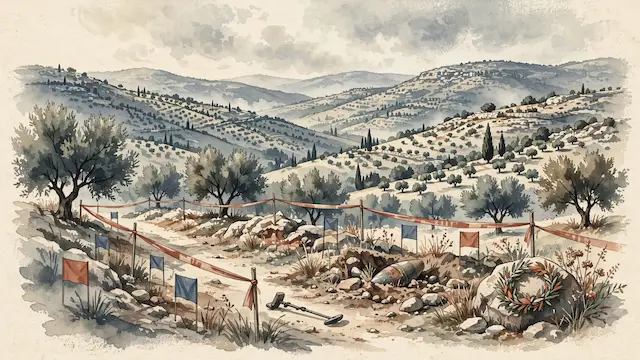
A recent fatal incident in the Ramim Ridge area of the Upper Galilee, where a 14-year-old boy was killed and 24 students and teachers were injured by an ammunition explosion, has highlighted the dangers of unexploded ordnance (UXO) in Israel's northern hiking areas. The tragedy occurred when a student apparently found a munition, suspected to be a Hezbollah cluster bomb, and placed it in his bag, leading to the blast and the hospitalization of dozens. This event underscores the reality of northern Israel after years of conflict, with open spaces and pastures still littered with unexploded shells.
In response, Moshe Davidovitch, Head of the Mateh Asher Regional Council and Chairman of the Confrontation Line Forum, has called for mandatory safety inspections for all official tours. Security forces and police are also reconsidering the continuation of tours in high-risk zones. Experienced tour guides are emphasizing strict safety protocols and heightened awareness for hikers.
Lior Shelef, a tour guide with 18 years of experience, stresses the need for a combination of established procedures and common sense. He explains that student groups require formal approval from the Ministry of Education and must have a guide, security, and first aid personnel. However, he notes that formal approvals are insufficient. "The guide's role is crucial; he walks first and can identify these things and draw people's attention," Shelef stated. He advises that if a suspicious object is found, one should not touch, approach, photograph, or share it online. Instead, the location should be marked, and authorities should be immediately alerted.
Shelef also advocates for developing awareness rather than instilling fear in young hikers. "The explanation is very simple: there is no need to scare, because that is not the goal," he said. "It is stated clearly: we are going to hike in the north, our north after three years of war, just open your eyes. If something doesn't look right to you, that's why there's a guide in front, point it out to him. Pay attention where you place your feet."
Retired Colonel Noam Ben Tzvi, a tour guide specializing in geopolitical tours along Israel's borders, offers a more complex perspective. He limits his tours to ages 15 and up due to the sensitive content but acknowledges the difficulty in fully controlling hikers' behavior. "You can say 'don't touch suspicious objects,' but a person or child goes two or three meters aside to urinate. If he stepped on something he didn't see or touched it, there's nothing I can do," Ben Tzvi explained. He believes that expecting all open areas to be cleared is unrealistic and that completely halting all tours due to fear is also not a viable solution. The immediate lesson from the Ramim Ridge disaster is clear: trails in the north require self-discipline, extreme caution, and a deep understanding that unexploded ordnance poses a real threat to life.
Mentioned
The same event, reported separately by each outlet. Open a few to compare what different newsrooms emphasize — and what they leave out.
Centre 3Right 2Haredi 1





Not the same event — other stories that share this one’s people, places, or theme: background, reactions, and follow-ups.




