Thousands of Palestinians Buried Under Gaza Rubble Amidst Identification Crisis
Translated & summarized from Behadrei Haredim by baba
Around 8,000 Palestinians are missing in Gaza, likely buried under 61 million tons of rubble, adding to over 74,000 war deaths. Rescue efforts are slow due to Israeli military control and a "Yellow Line" restricting access. Identification of bodies is difficult, with temporary burial sites and digital systems being used. Many families face prolonged uncertainty and psychological distress.
The story in 5 lines · by baba
- Approximately 8,000 Palestinians are missing in Gaza, presumed buried under 61 million tons of rubble.
- Rescue efforts are hindered by Israeli military control and a "Yellow Line" restricting access to burial sites.
- Identification of bodies is challenging due to lack of resources, with temporary burial sites established.
- International bodies have warned about the potential destruction of evidence and disrespect for the dead.
- Families face prolonged uncertainty, leading to psychological distress and "ambiguous loss."
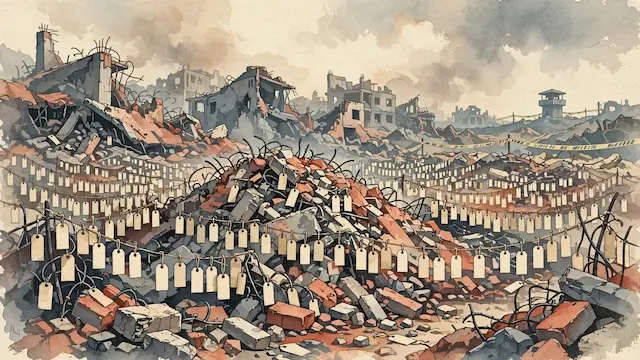
Approximately 8,000 Palestinians remain missing in the Gaza Strip, with the majority believed to be buried under an estimated 61 million tons of debris, according to Palestinian health ministry data. This figure adds to the over 74,000 reported deaths since the start of the war. Rescue efforts are significantly hampered by the "Yellow Line," a demarcation established during an October 2025 ceasefire mediated by the US, which restricts Palestinian access to areas where their relatives may be buried. The Israeli military currently controls over half of Gaza's territory. Recovery operations in accessible areas are proceeding slowly, with only two excavators operating in Gaza City and the central Strip. Mahmoud Bsal, a spokesperson for Gaza's Civil Defense, stated that teams have recovered around 1,000 bodies since last October but require dozens more engineering vehicles to complete the task. COGAT clarified that essential equipment is entering Gaza, but heavy machinery will be confiscated until Hamas disarms. International criticism has been raised regarding the clearing of rubble in Israeli-controlled zones. In September, UN High Commissioner for Human Rights Volker Turk warned that the use of bulldozers could disrespect the dead and obscure evidence of war crimes, echoing similar concerns from the Euro-Med Monitor. Even when bodies are found, identification is extremely difficult. Dr. Ahmed Deir, one of the three remaining forensic doctors in Gaza, told CNN that without DNA testing, refrigeration, and electricity, teams rely on basic blood typing and lab tests. A temporary solution involves a "cemetery of the missing" in Deir al-Balah, where about 1,000 unidentified individuals have been buried. Authorities and aid organizations are developing a digital information system to assign serial numbers to each grave, hoping for future scientific identification. For many families, this uncertainty has become a daily reality. Mohammed Yousef Shlail, who lost his mother, siblings, and their children in a November 2024 strike in Jabalia, cannot access the area beyond the Yellow Line. Suha Al Sharif is still searching for the remains of her son, Jihad, who was killed in late 2023 and whose body was lost during the evacuation of Shifa Hospital. Mental health organizations in Gaza report widespread "ambiguous loss," a psychological state where the unknown fate of loved ones prevents grieving and moving forward.
Mentioned
Not the same event — other stories that share this one’s people, places, or theme: background, reactions, and follow-ups.