
Questions Arise After Teen Killed by Unexploded Ordnance in Northern Israel
Translated & summarized from N12 by baba
A 15-year-old boy was killed and 20 others injured by unexploded ordnance during a school trip in northern Israel, prompting questions about trail safety. Authorities are investigating whether the area was cleared of explosives after years of conflict and who is responsible for safety. Past reports have criticized UXO clearance procedures, and while trails are generally open, the risk of unexploded ordnance remains, requiring hikers to exercise caution.
The story in 6 lines · by baba
- A 15-year-old boy died and 20 were injured by unexploded ordnance during a school trip in northern Israel.
- The incident raises concerns about the safety of hiking trails near the Lebanese border after years of conflict.
- It is unclear if the area where the explosion occurred was properly swept for unexploded ordnance before reopening.
- Responsibility for clearing unexploded ordnance is divided among multiple Israeli authorities.
- Past state comptroller reports have identified significant deficiencies in the country's UXO clearance mechanisms.
- Hikers are advised to stay on marked trails and report suspicious objects, as clearance is not guaranteed.
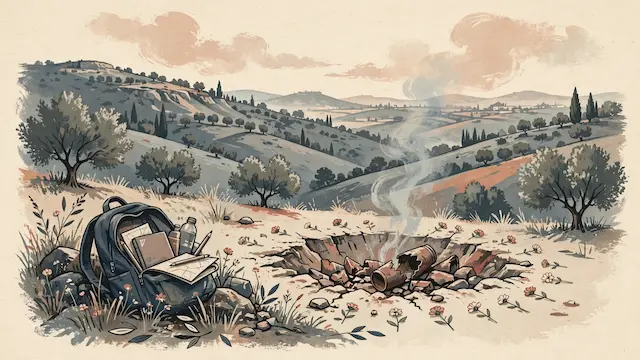
A 15-year-old boy was killed and approximately 20 others were injured in an explosion of unexploded ordnance (UXO) during a school trip near Mitzpe Pe'er in northern Israel. The incident has raised serious questions about the safety of hiking trails near the Lebanese border, particularly after three years of conflict with Hezbollah.
The area, which includes a popular section of the Israel Trail, experienced extensive Hezbollah rocket fire during the war. With hikers returning to the region, authorities are now tasked with determining if the area was cleared of UXO before being reopened to the public and who is responsible for ensuring trail safety.
Following a ceasefire in late 2024, the Israel Nature and Parks Authority announced trail mapping and safety checks. The IDF reported clearing UXO from over 40 northern communities, and in April 2026, the Nature and Parks Authority and KKL-JNF announced further sweeps. However, it remains unclear if the specific site of the explosion was inspected, when the last sweep occurred, or if the entire section of the Israel Trail was cleared.
School trips are subject to Ministry of Education regulations, requiring approval for routes that necessitate coordination. Investigations are underway to ascertain which route was approved, if students deviated from it, and if safety instructions were communicated. These instructions typically include staying on the path and not touching suspicious objects.
The responsibility for UXO clearance is shared among the IDF, police, and the Ministry of Defense's Mine and UXO Removal Administration, depending on the terrain and incident type. The Nature and Parks Authority and KKL-JNF manage recreational areas. The law allows the Minister of Defense to order these authorities to assist in clearing UXO from open areas affected by enemy fire. Questions are being raised about whether this authority was exercised in the northern border region and who coordinated information and approved the reopening of these areas.
Detecting UXO in open areas is challenging, as unexploded ordnance can remain hidden. The explosive device is suspected to be a submunition from a cluster bomb fired by Hezbollah during the war, which failed to detonate and was later triggered during the trip. While KKL-JNF and the Nature and Parks Authority publish information on open and closed trails, a consolidated list detailing which trails have been swept and when is not publicly available, leaving hikers unsure if a trail has been cleared.
Past state comptroller reports have highlighted deficiencies in UXO clearance mechanisms. A 2017 report found the system inadequate for safely clearing areas intended for civilian use, and a 2021 report addressed UXO clearance from training grounds. In May 2025, State Comptroller Matanyahu warned of negligence in clearing military industry complexes and handling hazardous materials, stating, "Explosives have already claimed human lives. The writing is on the wall, we must not wait for the next disaster." However, that report focused on industrial sites, not UXO in open combat zones.
While it is generally safe to hike on approved, open trails, the possibility of UXO cannot be entirely ruled out after years of conflict. Trail markings do not guarantee clearance. Hikers are advised to check trail status, heed warnings, stay on marked paths, and report any suspicious objects by calling 100.
Mentioned
The same event, reported separately by each outlet. Open a few to compare what different newsrooms emphasize — and what they leave out.
Centre 5Right 3Haredi 1Arab 1Other 5
















Not the same event — other stories that share this one’s people, places, or theme: background, reactions, and follow-ups.
