
Chinese Automakers Dominate Paris Auto Show, Eyeing Israeli Market
Translated & summarized from Globes by baba
Chinese automakers are increasingly dominating the Paris Motor Show, showcasing a wide range of electric and plug-in hybrid vehicles that are significantly undercutting European competitors on price and features. This trend is expected to further boost the presence of Chinese brands in the Israeli market, particularly in the affordable electric segment. While European manufacturers are attempting to compete in the premium segment, Chinese companies are also launching luxury models, though their high prices may limit their success in markets like Israel. Chinese advancements in autonomous driving technology are also on display, with many models set to arrive in Israel by 2027.
The story in 5 lines · by baba
- Chinese automakers are increasingly dominating the Paris Motor Show, with over 20 brands participating.
- Chinese electric and plug-in hybrid vehicles offer lower prices and better features than European competitors.
- The Israeli market is seeing a significant influx of affordable Chinese electric cars, impacting European brands.
- Chinese companies are also entering the premium automotive segment with luxury SUVs and crossovers.
- Advancements in autonomous driving technology from Chinese manufacturers are set to arrive in Israel by 2027.
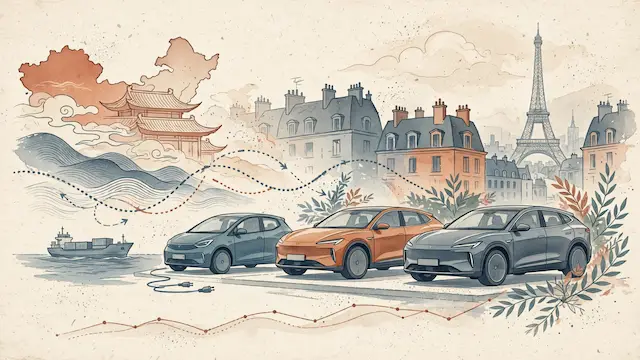
The Paris International Motor Show, historically a platform for European automakers, is increasingly showcasing Chinese manufacturers, with over 20 Chinese brands participating this year, making up a third of the exhibitors. This shift reflects a trend where European companies have reduced their presence due to cost-saving measures or a lack of new models, while Chinese firms have steadily gained ground.
While European manufacturers are attempting a comeback with new electric models, they face significant challenges from Chinese competitors. Chinese electric and plug-in hybrid vehicles are flooding the European market with lower prices, better equipment, and longer ranges, often at costs significantly lower than comparable European models, even after punitive tariffs. For instance, the Skoda EPIQ, priced around 28,000 euros in Germany, faces competition from the Geely E2, which offers more features and a longer range for about 4,000 euros less, despite import duties.
This competitive pressure is impacting the Israeli market, where Skoda's importer is hesitant to bring in the EPIQ at an estimated price of 140,000-150,000 shekels. In contrast, the Geely E2 is expected to arrive in Israel priced between 115,000-125,000 shekels. The dominance of Chinese brands in the affordable electric segment in Israel is expected to grow, as European regulations aimed at limiting imports and subsidies for foreign-made vehicles will not affect the Israeli market.
Chinese automakers are also targeting the premium segment, traditionally dominated by Western brands. New luxury Chinese SUVs and crossovers, featuring advanced technology and opulent interiors, are being unveiled. Brands like Zeekr, XPeng, and BYD's Denza are introducing models that, while expensive, are still priced below their Western luxury counterparts. For example, the Zeekr 9X is expected to cost around 120,000 euros in Europe, translating to approximately 525,000-600,000 shekels in Israel. However, the article notes that the 'glass ceiling' for premium Chinese cars in Israel appears to be around 300,000 shekels, with many Chinese brands having previously failed to penetrate this segment.
Furthermore, Chinese companies are leading the charge in autonomous driving technology, with several models at the show designed for driverless operation. This aligns with their strategy of deploying autonomous 'robotaxis' in Europe, often at a lower cost than Western systems. Some of these autonomous Chinese vehicles are already sold in Israel, awaiting regulatory approval, with many more expected by 2027, potentially shaping the future of the automotive industry in Europe and Israel.
Mentioned
The same event, reported separately by each outlet. Open a few to compare what different newsrooms emphasize — and what they leave out.
Other 2

Not the same event — other stories that share this one’s people, places, or theme: background, reactions, and follow-ups.
